
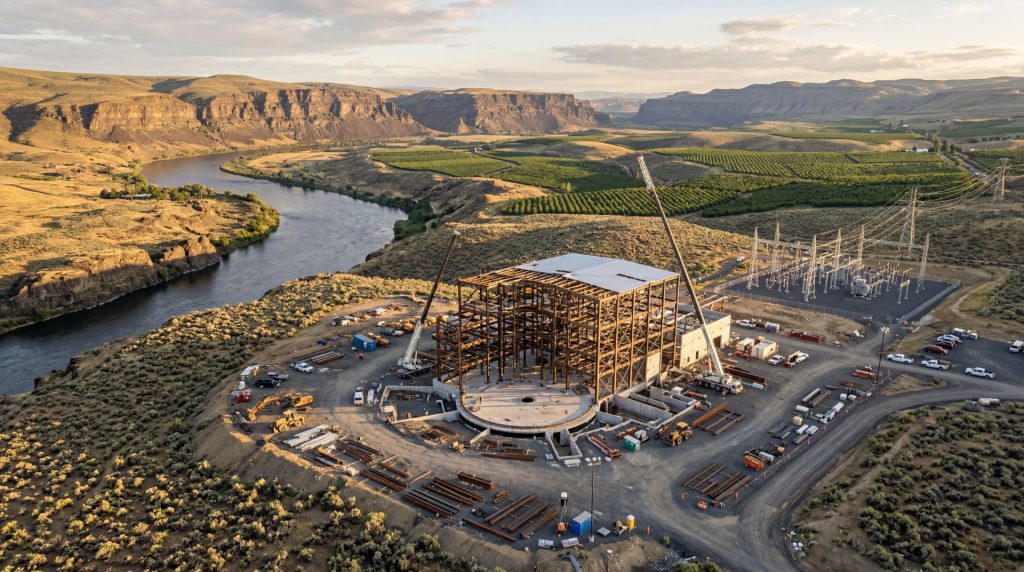
What Is Fusion Balance of Plant? The Systems Around the Reactor That Decide Whether It Makes Power
The fusion core gets the headlines. The balance of plant, everything that fuels it, cools it, powers it, and turns its heat into electricity, is most of the facility.
By Timothy Porritt · Porritt Inc. · November 21, 2026
In a power plant, balance of plant means everything outside the core heat source that is needed to turn that heat into a product. For a fusion plant the term covers a wide and unfamiliar set of systems, and together they account for much of the equipment, the building volume, and the engineering hours.
What Sits Around the Fusion Core
- Heat transfer and power conversion. Coolant loops carry heat from the blanket and plasma-facing components to a turbine cycle or a process heat user. Candidate coolants include helium, water, molten salt, and liquid metal, each with a different temperature range and set of materials problems.
- Fuel cycle. Systems that store, inject, recover, purify, and recycle hydrogen isotopes, covered in Tritium Systems Explained.
- Cryogenics. Refrigeration for superconducting magnets and cryopumps, covered in Fusion Cryogenic Systems.
- Vacuum. Pumping to reach and hold the vacuum the plasma requires, and to remove exhaust.
- Magnet and heating power supplies. Large converters, energy storage, and in pulsed concepts capacitor banks or other pulsed-power systems.
- Plant electrical. Grid connection, house loads, and emergency power.
- Instrumentation, control, and data acquisition. Covered in Fusion Plant Control Architectures.
- Remote handling and waste. Maintenance of activated components and management of the resulting material.
- Cooling water and heat rejection. Ultimately most of the thermal energy leaves through a cooling tower or equivalent.
What Is Borrowed and What Is New
Some of this is mature. Steam turbines, generators, cooling towers, switchyards, and distributed control systems are bought from an existing supply chain. Large helium refrigerators exist at research facilities. Other parts have no industrial precedent at plant scale: breeding blankets, continuous tritium processing, and heat removal from components exposed to intense neutron flux.
The engineering challenge is the interfaces. A turbine cycle designed for steady heat input has to live with a source that may pulse. A coolant chosen for thermal efficiency also has to be compatible with tritium control. Decisions made for the core ripple outward.
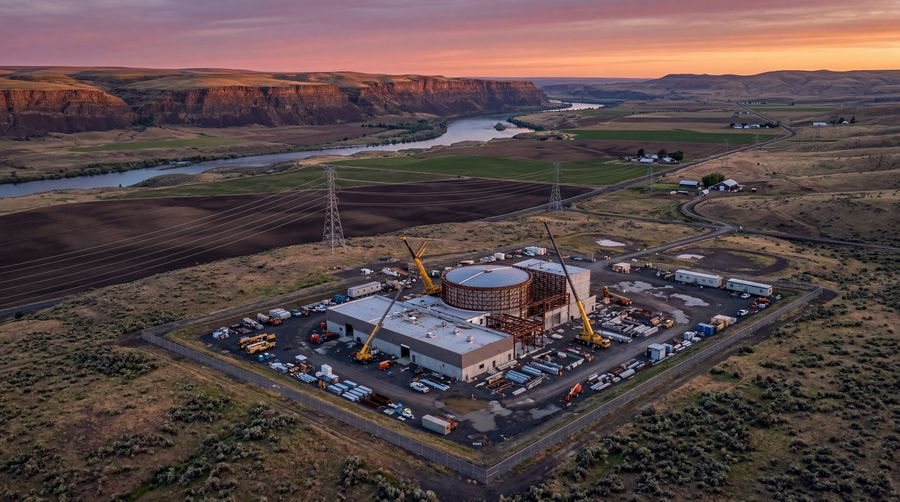
Recirculating Power
A fusion plant consumes a meaningful fraction of its own output to run magnets, cryogenics, heating systems, pumps, and fuel processing. Net electricity is gross generation minus that recirculating load. Balance-of-plant efficiency therefore has a direct effect on whether a design that achieves physics gain also achieves useful net power.
Why It Matters
As private fusion companies move from experiments toward pilot plants, the questions shift from plasma performance to plant engineering: what does it cost, how available is it, and can it be licensed and maintained. Those are balance-of-plant questions. Progress reports from the leading developers, such as those summarized in DOE’s October Fusion Scorecard, increasingly concern hardware outside the plasma.
It is also where existing industrial experience transfers. Engineers from refining, chemicals, gas processing, and fission power already know high-temperature heat exchange, hazardous gas handling, cryogenic operations, and safety instrumented systems.
Related reading
- Tritium Systems Explained: The Fuel Cycle Inside a Fusion Plant
- Fusion Plant Control Architectures: Plasma Control, Plant Control, Interlocks, and Safety
- Fusion Cryogenic Systems Explained: Why a Machine at 100 Million Degrees Needs a Refrigerator
- Fusion Plant Cybersecurity: Designing First-of-a-Kind Plants So a Bad Command Cannot Break Them
Timothy Porritt is founder of Porritt Inc., building AI-powered tools for process safety, engineering compliance, and industrial operations. Based in Salt Lake City, Utah. Contact: timothy@porrittinc.com.

