
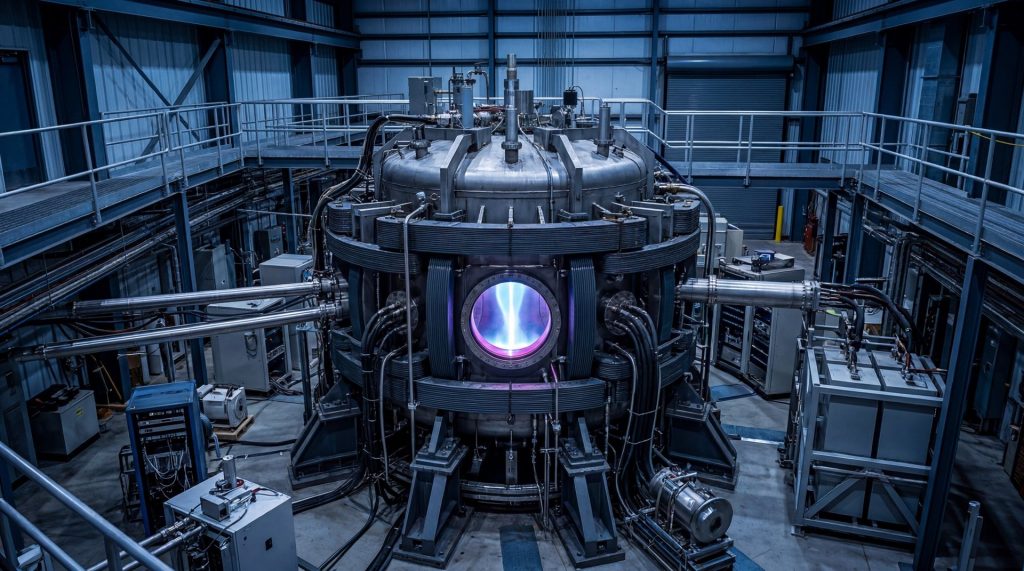
Fusion Plant Cybersecurity: Designing First-of-a-Kind Plants So a Bad Command Cannot Break Them
Fusion plants will be digital from day one, with heavy use of software-defined control. That makes them a clean-sheet opportunity for Cyber-Informed Engineering.
By Timothy Porritt · Porritt Inc. · November 21, 2026
No fusion power plant has been attacked, because none exists yet. That is the reason to think about it now. The first plants are being designed today, they will depend on software more than any previous generation of power plant, and the cheapest time to make them resilient is before the drawings are issued.
What Is at Stake
A fusion plant has no chain reaction to run away, and the amount of fuel in the plasma at any moment is small. The consequences that matter are different from fission:
- Damage to very expensive, long-lead equipment. Superconducting magnets, vacuum vessels, and plasma-facing components can be damaged by a mishandled fault, an unmitigated loss of plasma confinement, or operation outside limits.
- Release of tritium or activated material. The fuel cycle and confinement systems hold the plant’s radiological inventory.
- Stored energy. Magnets and pulsed-power systems hold large amounts of energy that must be discharged in a controlled way.
- Extended outage. For a first-of-a-kind plant, a year lost to repairs can decide a company’s future.
- Loss of proprietary design and operating data.
Why First-of-a-Kind Plants Are Exposed
- Control software changes frequently as operators learn the machine.
- Research heritage favors open data access and remote participation.
- Many suppliers deliver packaged systems with their own controllers and remote support connections.
- Machine learning is being introduced into control loops, adding models and training pipelines to the list of things to protect.
- Small developer teams are focused, reasonably, on making the machine work.
Applying Cyber-Informed Engineering
Cyber-Informed Engineering starts from consequences and asks which of them a digital system could cause. For a fusion plant that leads to a few concrete design positions:
- Keep machine protection independent. Quench detection and energy extraction, and other investment-protection functions, should not rely on the control network or share its hardware. See Fusion Plant Control Architectures.
- Use passive and hardwired protection where physics allows. Relief devices, dump resistors, and hardwired permissives act regardless of software state.
- Limit what software can command. Physical limits on power supply voltage, valve travel, and fueling rate bound the worst case.
- Design the tritium confinement boundary so no control action can open it inadvertently.
- Treat remote access as a design decision. Decide which systems may ever be reached from outside and build the architecture to enforce it.
- Write security into procurement. Packaged systems arrive with whatever the specification asked for.
- Control engineering information. Protection settings and control logic deserve handling rules of their own.
The Regulatory Picture
In the United States, fusion machines are being regulated under the framework for radioactive materials rather than as fission reactors. That generally means lighter prescriptive requirements, which leaves more of the responsibility for cyber resilience with the developer and its investors. Customers buying power for critical loads will ask their own questions.
Why It Matters
Fusion developers have an advantage no existing industry has: nothing is built yet. Protection designed in at this stage costs engineering hours. The same protection added after commissioning costs outages. The twelve principles in The INL CIE Framework Explained are a practical starting list for a design review.
Related reading
- What Is Fusion Balance of Plant? The Systems Around the Reactor That Decide Whether It Makes Power
- Tritium Systems Explained: The Fuel Cycle Inside a Fusion Plant
- Fusion Plant Control Architectures: Plasma Control, Plant Control, Interlocks, and Safety
- Fusion Cryogenic Systems Explained: Why a Machine at 100 Million Degrees Needs a Refrigerator
Timothy Porritt is founder of Porritt Inc., building AI-powered tools for process safety, engineering compliance, and industrial operations. Based in Salt Lake City, Utah. Contact: timothy@porrittinc.com.

