A star is easy to admire.
Hard to operate.
Everyone talks about the plasma. We build everything around it. Balance of plant is the 80% of a fusion or advanced-fission facility that determines whether a physics milestone becomes a power plant: heat transport, power conversion, fuel cycle, cryogenics, vacuum, electrical, and the supervisory control layer that makes ten thousand devices behave as one machine. Porritt Inc. designs, instruments, and controls that plant.
Built on what we run today.
The fusion plant architecture is not a blank-sheet idea. It is the same supervisory layer, process-safety discipline, and compliance tooling Porritt Inc. applies to refineries and process facilities now, carried forward to a new heat source.
Refinery controls
Unit-level SCADA, PSM-aware interlocks, integrity-informed operations for refineries and chemical plants.
PSM software
NORMEX Standards AI: cited answers from the actual OSHA, EPA, API and ASME text.
Compliance systems
29 CFR 1910.119 program builds, PHA facilitation, audits, MOC, RAGAGEP reviews.
Operational software
NEXUS engineering suite and Plant Intelligence: design, certify, operate on one tag namespace.
Show, don't tell.
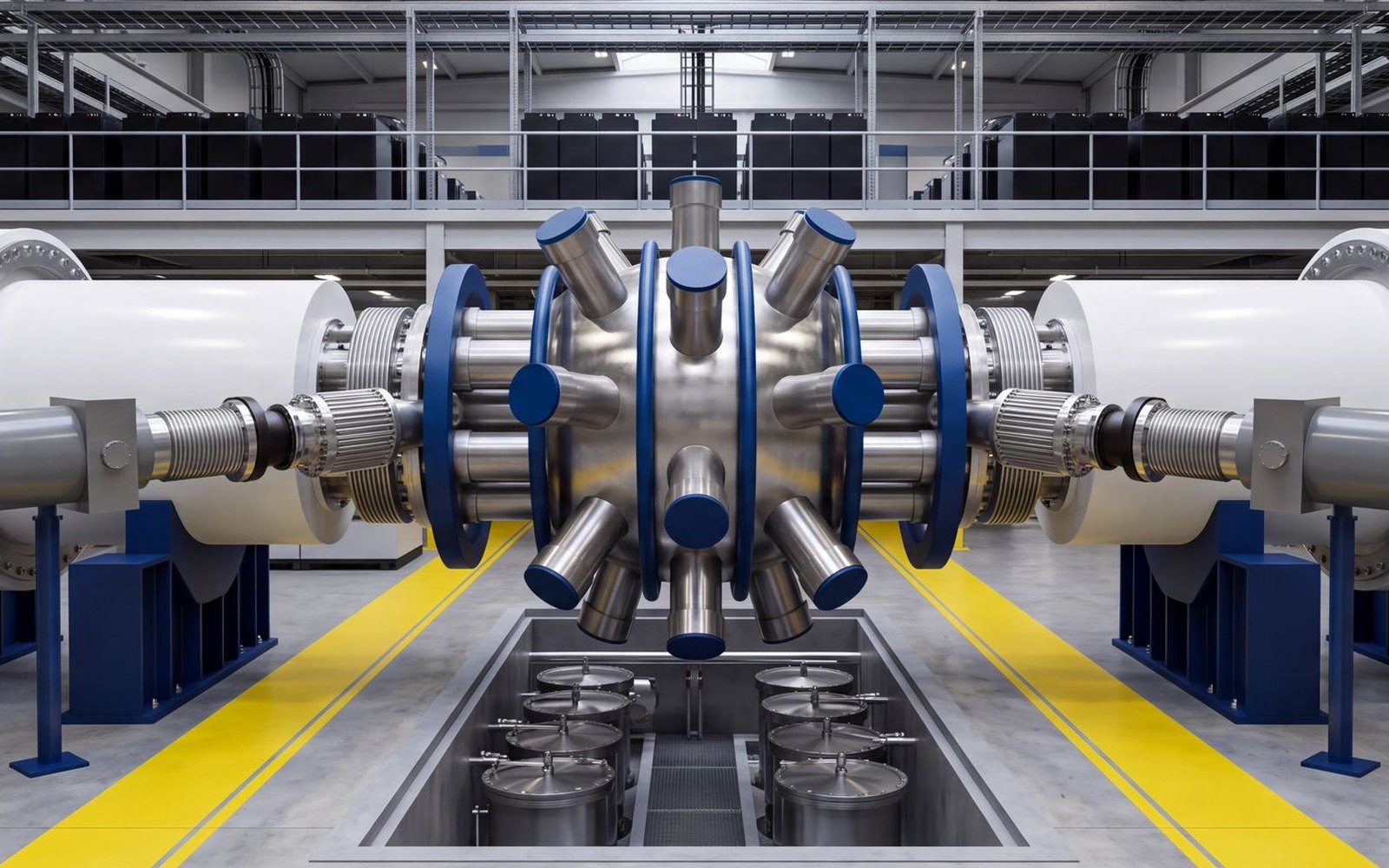
HELIA Fusion Balance-of-Plant
The balance-of-plant architecture developed by Porritt Inc. enables a common control strategy across advanced fission systems today and commercial fusion systems tomorrow. Heat transport, power conversion, fuel cycle, cryogenics, vacuum, plant electrical, and supervisory control — designed as one plant, run by one operating layer.
Shown: the Porritt Inc. plant architecture around the heat source. The machine physics stays with the machine builder; everything outside the vessel is ours.
FUSION COLLABORATION INQUIRY →Not only a plasma problem. A plant problem.
Most future fusion capital will be spent outside the plasma vessel. The cooling, cryogenics, fuel-handling, electrical, controls, grid interface, safety systems, and the analytics that run them are the part of a fusion facility that already exists in today's engineering practice — and the part Porritt Inc. designs, instruments, and controls.
Primary Coolant Loop
Dual molten-salt loops carry blanket heat to the power island. Intermediate heat exchangers isolate activated coolant from the clean secondary side, with drain tanks and freeze-plug protection on every leg.
Power Conversion
Supercritical CO₂ Brayton cycle converts blanket heat to grid electricity at high efficiency in a compact footprint — printed-circuit heat exchangers, integrally geared turbomachinery, dry-cooling option for arid sites.
Tritium Fuel Cycle
Closed-loop tritium plant: breeding-blanket extraction, isotope separation, cryogenic distillation, and metal-hydride storage beds, with full accountancy at every transfer point and double containment throughout.
Cryoplant
Helium refrigeration delivers 4.5 K cold power to the superconducting magnet set, with 80 K thermal shields and quench-recovery surge volumes. Liquefier sized for full cooldown in under three weeks.
Vacuum Systems
Staged roughing, turbomolecular, and cryosorption pumping hold the torus at ultra-high vacuum and the cryostat at insulating vacuum, with regeneration sequencing that keeps pumping continuous through long burns.
Plant Electrical
Generator step-up, auxiliary distribution, and pulsed-power interfaces for magnet and heating systems — ride-through design keeps the plant stable through grid transients and plasma events alike.
I&C / SCADA — the Jarvis layer
EPICS-based supervisory control: 50,000+ live tags, machine-protection interlocks with sub-10 ms trip latency, and an operator HUD designed like a flight deck, not a filing cabinet. We interface cleanly with the plasma controller at the balance-of-plant boundary — the machine physics stays with the machine builder; the plant is ours.
Why our BoP architecture is different.
Most plant control stacks were designed around one vendor, one heat source, and a human watching a screen. HELIA was designed around the plant.
| Traditional DCS | Porritt BoP (HELIA) |
|---|---|
| Vendor locked | Vendor neutral — open EPICS-based supervisory layer |
| Heat-source specific | Heat-source agnostic — fission first, fusion ready |
| Human driven | AI assisted — operator HUD with an advisory layer |
| Static analytics | Predictive analytics — integrity and degradation modeling in the loop |
| Separate systems | Unified architecture — one tag namespace, one trip path, one plant picture |
Fusion BoP questions.
What is balance-of-plant?
Balance of plant (BoP) is everything in a power plant other than the heat source itself: the coolant loops that carry heat away, the turbines or sCO₂ cycle that turn heat into electricity, the fuel-handling systems, cryogenics, vacuum, plant electrical, cooling water, and the instrumentation and control system that runs all of it. In a fusion or advanced-fission facility it is the part that turns a physics result into a power plant.
Why is balance-of-plant roughly 80% of a power plant?
The reactor or fusion machine is a small fraction of the site by equipment count, piping, cable, and capital. The heat-transport loops, power-conversion island, fuel cycle, cryoplant, vacuum plant, switchyard, and control system account for most of the engineering hours, most of the procurement, and most of what can go wrong during operation. That is why Porritt Inc. focuses there.
What does "fission first, fusion ready" mean?
Our plant architecture is heat-source agnostic. The initial operating run is on fission heat, with engineered tie-in taps to retrofit fusion heat sources after testing. The balance of plant and the control layer that runs it carry forward unchanged, so the plant outlives its first heat source.
Does Porritt Inc. design the fusion reactor itself?
No. Porritt Inc. designs, instruments, and controls the plant around the machine. We interface with the plasma or reactor controller at the balance-of-plant boundary; the machine physics stays with the machine builder.
What is HELIA?
HELIA is Porritt Inc.'s fusion balance-of-plant platform: the engineering workbench, the supervisory control layer, and the plant architecture that lets advanced fission systems today and commercial fusion systems tomorrow share one control strategy.
Fission first. Fusion ready.
Our plant architecture is heat-source agnostic by design: an initial operating run on fission heat with engineered tie-in taps to retrofit fusion heat sources after testing. The balance of plant — and the control layer that runs it — carries forward unchanged. That is how you de-risk fusion: build the plant that outlives its first heat source.
Layton, Utah.
American-built.
Porritt Inc. is an energy-technology company building the software, controls, and hardware layer for complex energy facilities — from refineries to fusion balance of plant. Founded and led by Timothy Porritt. Registered and active on SAM.gov (CAGE 9Z7B9) for federal and national-laboratory teaming.
See the rest of the stack
Software families, neuromorphic R&D, HPC hardware, and balance-of-plant control across process, marine, and defense sensing.
EXPLORE SOFTWARE → CONTACT