What Is RAGAGEP? Recognized and Generally Accepted Good Engineering Practices, Explained
RAGAGEP is the phrase that ties OSHA PSM to the codes and standards of the engineering profession. It appears in a few sentences of the rule and drives a large share of citations.
By Timothy Porritt · Porritt Inc. · November 21, 2026
RAGAGEP stands for Recognized and Generally Accepted Good Engineering Practices. It is how OSHA’s Process Safety Management standard avoids writing its own design code: instead of specifying how to size a relief valve or how often to inspect a vessel, the rule requires employers to follow the practices the profession already recognizes.
Where It Appears in the Standard
- Process safety information, 1910.119(d)(3)(ii): the employer must document that equipment complies with RAGAGEP.
- Older equipment, (d)(3)(iii): for equipment built to codes no longer in general use, the employer must determine and document that it is designed, maintained, inspected, tested, and operating in a safe manner.
- Mechanical integrity, (j)(4)(ii) and (iii): inspection and testing procedures must follow RAGAGEP, at a frequency consistent with manufacturers’ recommendations and good engineering practice, and more often if operating experience calls for it.
What Counts as RAGAGEP
OSHA’s enforcement guidance, issued in 2015 and revised in 2016, describes the main sources:
- Widely adopted codes such as the ASME Boiler and Pressure Vessel Code and NFPA codes
- Consensus documents such as API inspection codes and recommended practices
- Non-consensus documents such as industry association guidance and CCPS guidelines
- Internal standards the employer develops, where published ones do not exist or the employer chooses to exceed them
The employer selects the RAGAGEP it will apply. Once selected and documented, that is the yardstick the facility is measured against.
Shall and Should
The guidance draws a practical line. “Shall” and “must” in a selected RAGAGEP reflect minimum requirements, and deviation is presumed to be a problem. “Should” reflects an acceptable and preferred approach; an employer that does something different needs to be able to show its alternative is at least as protective.
The Currency Problem
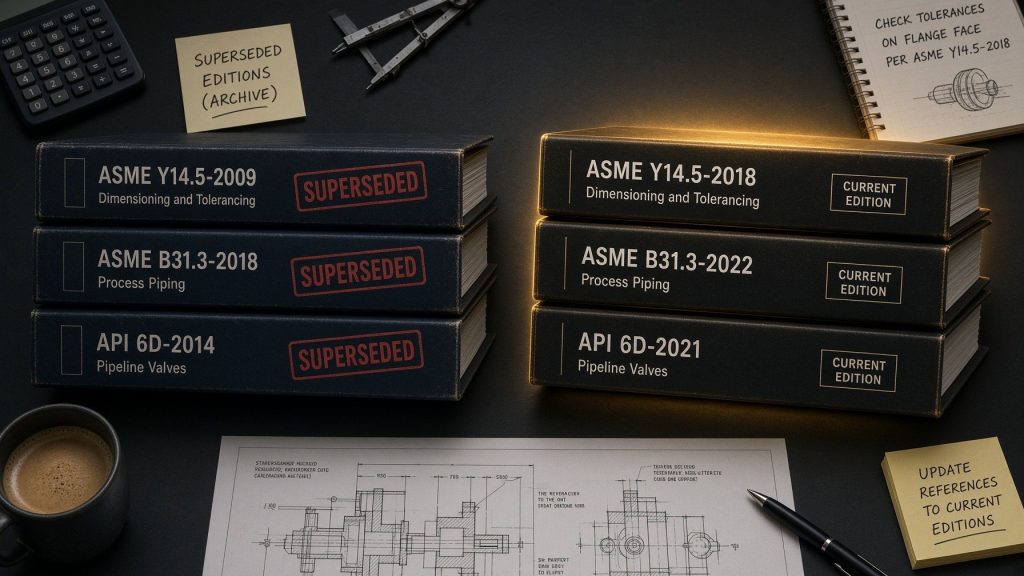
Standards are revised on a regular cycle. A facility designed to a 2008 edition is not automatically out of compliance when the 2020 edition appears, but it cannot ignore the change either. The employer is expected to know that the practice has moved, evaluate whether the new provisions address a hazard that applies, and document the conclusion.
This is where programs slip. Process safety information cites editions nobody has checked in years. Inspection procedures reference withdrawn documents. PHAs judge safeguards adequate against superseded criteria. A method for finding these gaps is in How to Run a RAGAGEP Currency Check in 5 Steps.
Internal Standards Cut Both Ways
A company engineering standard is RAGAGEP for that company. If it sets an inspection interval shorter than the published code, the shorter interval is the one that applies, and failing to meet your own standard is citable.
Why It Matters
RAGAGEP findings are among the most frequent in PSM enforcement because they are easy to demonstrate: the inspector compares what the document says with what the code requires. They are also a real indicator of risk. Equipment that has drifted away from current practice is equipment whose design basis nobody is actively managing.
See also Mechanical Integrity Program Guide and OSHA PSM Explained.
Related reading
- OSHA PSM Explained: The 14 Elements of 29 CFR 1910.119
- Process Hazard Analysis (PHA): A Practical Guide to What OSHA Requires and What Good Looks Like
- PHA vs. HAZOP: What Is the Difference, and Which Does OSHA Require?
- Mechanical Integrity Program Guide: What OSHA 1910.119(j) Requires and How to Build It
Timothy Porritt is founder of Porritt Inc., building AI-powered tools for process safety, engineering compliance, and industrial operations. Based in Salt Lake City, Utah. Contact: timothy@porrittinc.com.