
OSHA PSM Explained: The 14 Elements of 29 CFR 1910.119
The Process Safety Management standard is a management system for preventing catastrophic releases. Here is what each of its fourteen elements requires.
By Timothy Porritt · Porritt Inc. · November 21, 2026
OSHA’s Process Safety Management of Highly Hazardous Chemicals standard, 29 CFR 1910.119, took effect in 1992 after a series of catastrophic industrial accidents in the 1980s. It is a performance-based rule: it tells employers what their safety management system must accomplish and leaves much of the how to them.
Who Is Covered
The standard applies to a process that involves a chemical listed in Appendix A at or above its threshold quantity, or 10,000 pounds or more of flammable liquids or gases, with specific exemptions such as retail facilities, oil and gas well drilling and servicing, normally unoccupied remote facilities, and certain atmospheric storage. Refineries, chemical plants, gas processing, and many ammonia refrigeration and chlorine systems are covered.
The Fourteen Elements
- Employee participation. A written plan for involving employees in PHAs and other elements, with access to the information.
- Process safety information. Hazards of the chemicals, technology of the process, and equipment design basis, including documentation that equipment complies with good engineering practice. See What Is RAGAGEP?.
- Process hazard analysis. A team study of what can go wrong, revalidated at least every five years. See the PHA Guide.
- Operating procedures. Written instructions for each operating phase, operating limits, and safety considerations, certified annually as current and accurate.
- Training. Initial training and refresher at least every three years, with documentation that the employee understood it.
- Contractors. Evaluating contractor safety performance, informing contractors of hazards, and contractor employer responsibilities.
- Pre-startup safety review. Confirmation before introducing highly hazardous chemicals to a new or modified facility that construction, procedures, PHA, and training are complete.
- Mechanical integrity. Written procedures, inspection and testing, deficiency correction, and quality assurance for critical equipment. See the Mechanical Integrity Program Guide.
- Hot work permit. A permit for hot work on or near a covered process.
- Management of change. Written procedures to manage changes to chemicals, technology, equipment, procedures, and facilities, other than replacement in kind.
- Incident investigation. Investigation of incidents that resulted in, or could reasonably have resulted in, a catastrophic release, started within 48 hours, with reports kept five years.
- Emergency planning and response. An emergency action plan for the whole plant.
- Compliance audits. Certification at least every three years that the employer has evaluated compliance, keeping the two most recent reports.
- Trade secrets. Information must be made available to those who need it, regardless of trade secret status, subject to confidentiality agreements.
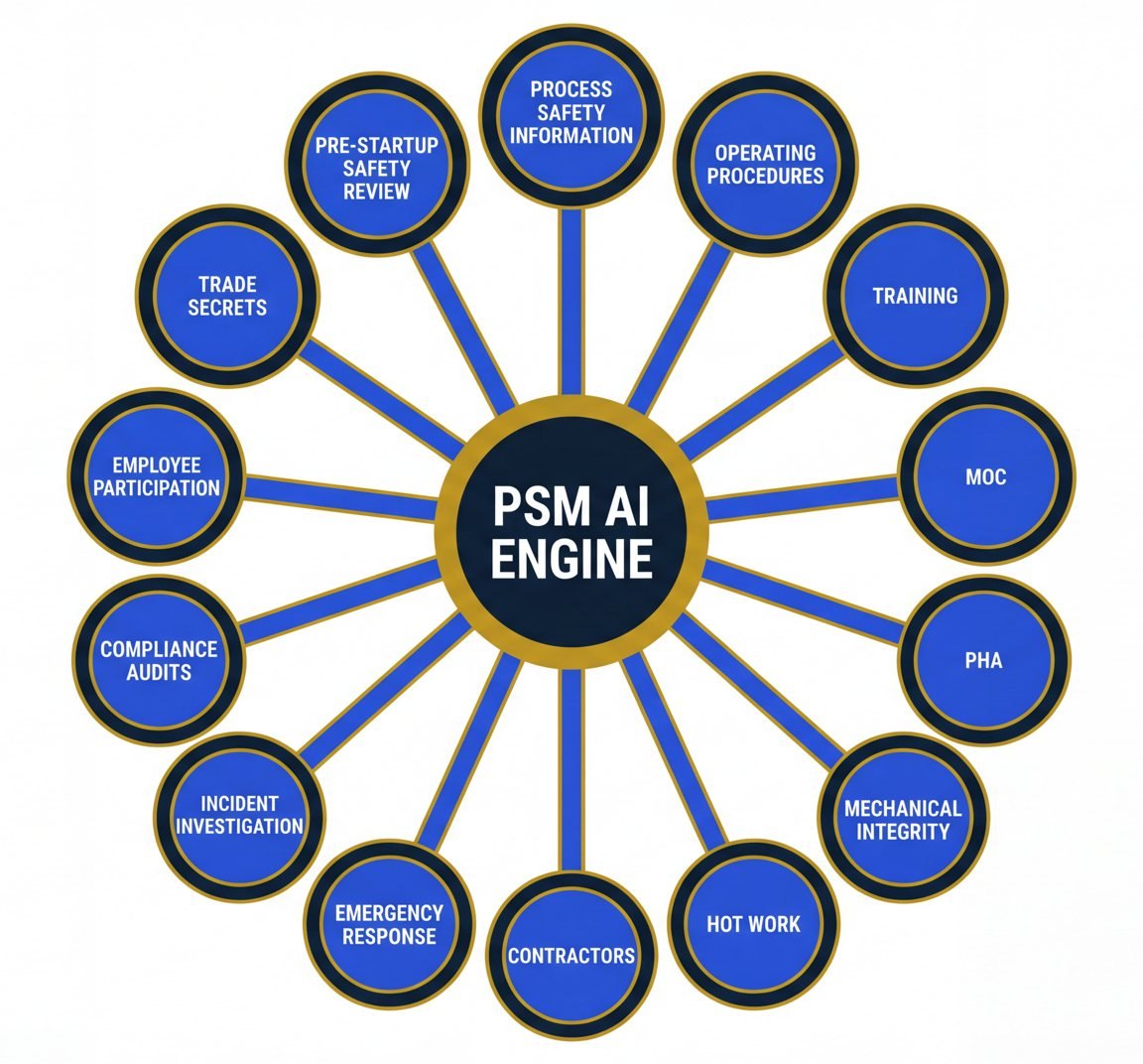
How the Elements Depend on Each Other
The elements are not independent. Process safety information feeds the PHA. The PHA drives operating limits, procedures, and the list of safeguards that mechanical integrity must maintain. Management of change keeps all of it current. When one element is weak, the others inherit the weakness, which is why audits often find the same root problem under several headings.
Where Facilities Struggle
- Process safety information that no longer matches the plant
- PHA recommendations left open
- Changes made without management of change, especially temporary ones and control system changes
- Overdue inspections and unresolved equipment deficiencies
- Annual procedure certification done as a signature exercise
A less obvious gap is covered in The PSM Compliance Gap Most Refineries Don’t Know They Have.
Why It Matters
PSM citations carry significant penalties, discussed in OSHA’s 2026 Penalties. More to the point, the standard encodes lessons from real disasters, and the major accidents since it took effect have generally involved a failure of one or more of these fourteen elements.
Related reading
- Process Hazard Analysis (PHA): A Practical Guide to What OSHA Requires and What Good Looks Like
- PHA vs. HAZOP: What Is the Difference, and Which Does OSHA Require?
- What Is RAGAGEP? Recognized and Generally Accepted Good Engineering Practices, Explained
- Mechanical Integrity Program Guide: What OSHA 1910.119(j) Requires and How to Build It
Timothy Porritt is founder of Porritt Inc., building AI-powered tools for process safety, engineering compliance, and industrial operations. Based in Salt Lake City, Utah. Contact: timothy@porrittinc.com.