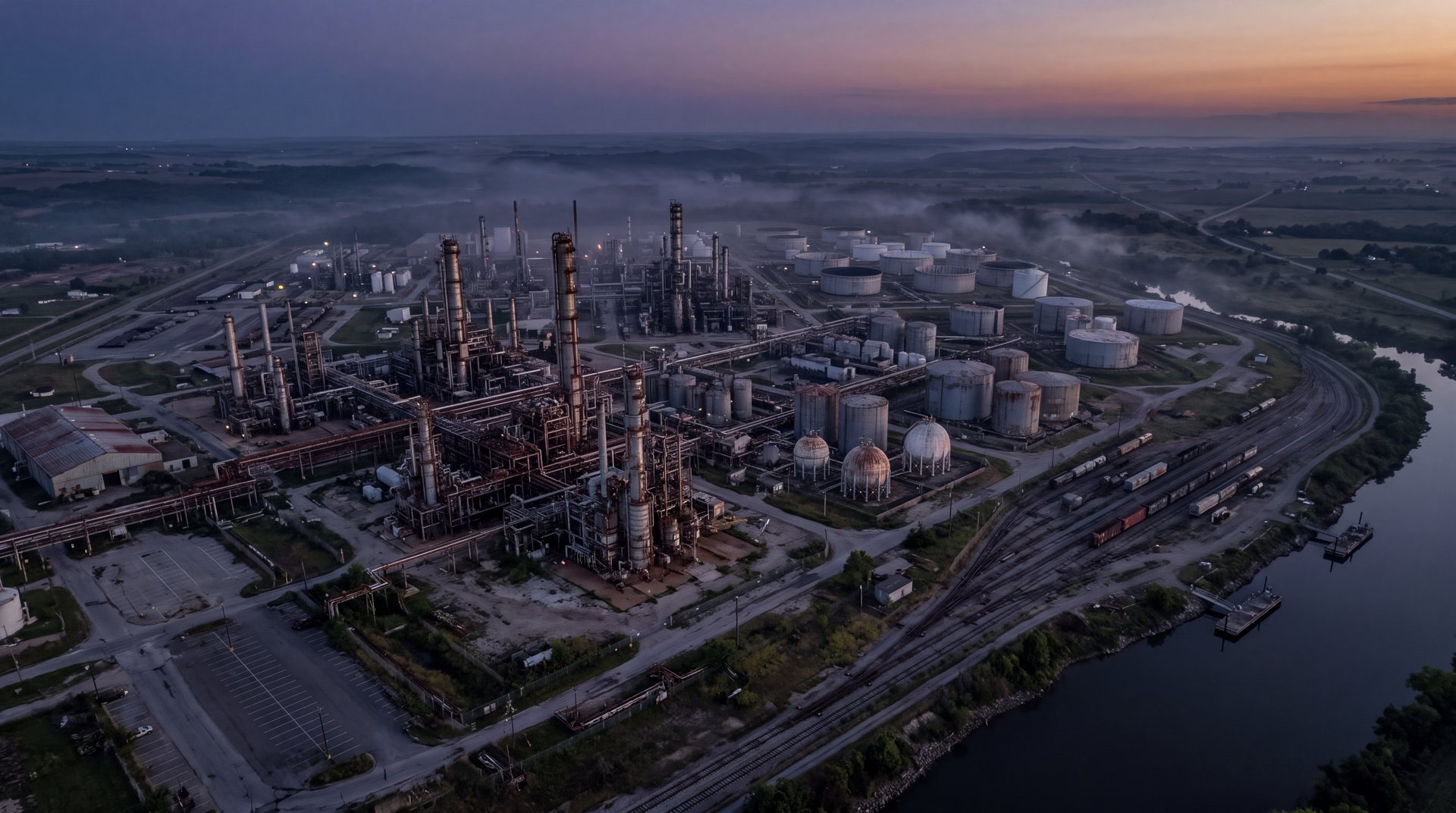
Crude Craters 8.7% on Iran De-Escalation — Diesel Cracks Barely Blinked
U.S. distillate stocks just hit their lowest level since 2003. That is why refining margins decoupled from the crude price crash this week.
By Timothy Porritt · Porritt Inc. · November 9, 2026
On November 4 and 5, Brent crude fell 8.7% in a single session and nearly 20% on the week, as reports that the United States and Iran had agreed to a weekend pause in hostilities around the Strait of Hormuz pulled a war-risk premium out of the crude market almost overnight. December WTI fell 8.3% to $88.05 a barrel. The S&P Energy sector index dropped 4.77%. By any normal reading of the oil market, that is the kind of move that should ripple straight through to every downstream product, refining margins included.
It did not. The diesel crack spread — the margin a refiner earns converting a barrel of crude into diesel — held near $87.40 a barrel on November 4, deep in the upper end of its own twelve-month range of $26 to $115 and well above the trailing twelve-month average of $63. Crude cratered. Diesel margins did not follow it down.
For a physicist or a refinery economist, that divergence is not noise — it is the market telling you that two different supply-demand balances are being priced at the same time, and that this week’s geopolitical news only touched one of them.
Two Different Markets, Priced on Two Different Clocks
Crude oil is a global, fungible commodity whose price reflects the marginal barrel’s geopolitical and logistics risk in real time. A Strait of Hormuz de-escalation removes transit risk for roughly a fifth of the world’s seaborne crude and condensate trade, so crude sold off within hours of the news. Distillate — diesel, heating oil, and jet fuel’s close cousin — is a different animal. It is a refined product with its own, much less elastic, supply chain: a fixed set of conversion units (hydrocrackers, fluid catalytic crackers, cokers) running at a fixed utilization rate, feeding a demand base — freight, agriculture, rail, marine bunkering, winter heating — that does not reprice itself on a weekend ceasefire announcement.
The crack spread is the arithmetic that connects the two: it is simply the refined product price minus the crude input cost, expressed per barrel. When crude falls faster than diesel, the crack spread widens — exactly what happened this week. That is not a quirk; it is the crack spread doing its job, showing that the constraint on diesel supply right now is refining capacity and inventory, not crude availability.
The Number That Explains Everything: 99.2 Million Barrels
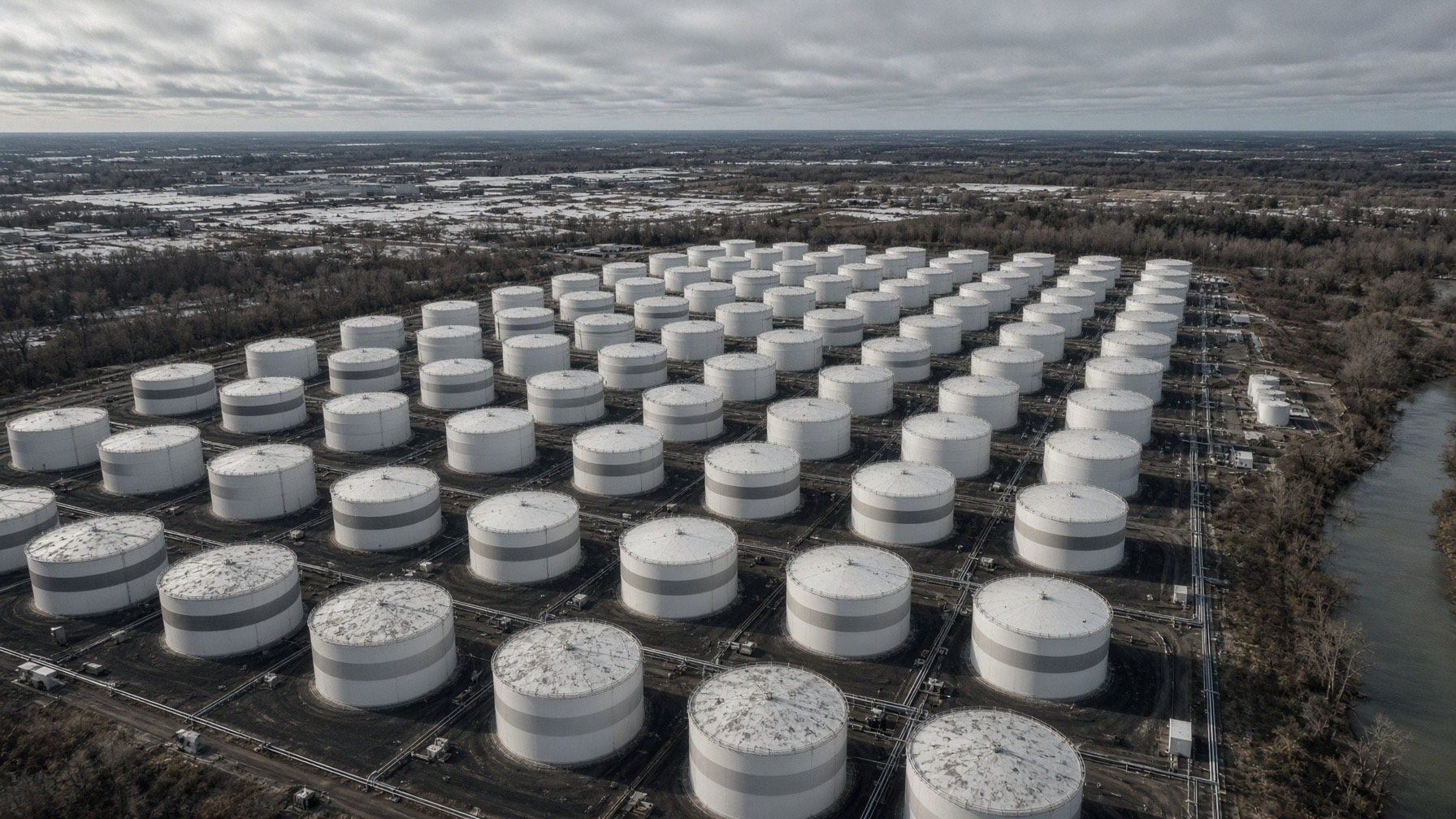
U.S. commercial distillate stocks fell another 3.6 million barrels in the week ending October 30, to about 99.2 million barrels. That is the lowest distillate inventory level recorded since 2003, and it sits roughly 13% below the five-year seasonal average — a gap that would need to close by more than 7 million barrels just to reach the bottom of the normal five-year band, according to EIA data cited in refining-margin coverage this week. Total commercial petroleum inventories fell 8.2 million barrels over the same week.
The demand side is not cooperating with a restock, either. Four-week average distillate demand is running 8.7% above a year ago, at roughly 4.2 million barrels per day, even as U.S. refineries are already working hard to meet it: 16.7 million barrels per day of crude runs at 94.5% utilization, yielding about 5.2 million barrels per day of distillate. There is very little spare refining capacity left to throw at the problem. Refiners are close to running flat-out, and the barrels still are not accumulating.
Meanwhile, Gulf Coast crude exports averaged 17.1 million barrels per day in October, down from September — a reminder that the U.S. refining system is simultaneously a major net exporter of crude and a market short of its own diesel, which is a capacity-mix problem, not a crude-supply problem.
Why This Isn’t a One-Week Story
The structural piece of this is the part that should concern anyone thinking past this week’s headlines. Wood Mackenzie’s Alan Gelder, Senior Vice President for Refining, Chemicals and Oil Markets, has pointed to global refined product demand climbing from roughly 105 million barrels per day in 2025 toward a projected peak near 108 million barrels per day by 2032 — even as the firm estimates that about 20% of capacity across more than 700 refineries worldwide is at risk of closure over the coming years. Global distillation capacity stood at roughly 103.3 million barrels per day as of January 2026, with net capacity additions running at only a little over 400,000 barrels per day annually. S&P Global Energy’s separate projection for Europe alone — capacity falling from about 14 million barrels per day around 2000 to just over 9 million barrels per day by 2035, with roughly 500,000 barrels per day shut in 2025 — tells the same story in one region: refining capacity is contracting in the parts of the world that can least afford to lose distillate supply.
Put those two numbers next to each other — demand drifting up toward 108 million b/d, net capacity additions of ~400,000 b/d per year against a backdrop of 20% of existing capacity at closure risk — and the diesel crack spread’s resistance to a crude crash stops looking surprising. It looks like exactly what a market with a shrinking margin of safety on the conversion side should do.
Who Captures the Margin — and Who’s Exposed
Large integrated refiners with scale, feedstock flexibility, and the balance sheet to hedge crude price swings have real advantages here: they can shift crude slates toward heavier, cheaper barrels that still yield well on distillate-forward hydrocracking trains, and they can absorb a volatile week like this one without disrupting term supply contracts. That scale advantage is genuine, and it is why the majors with distillate-heavy, hydrocracking-forward refining configurations are the ones best positioned to capture a crack spread like $87.40 a barrel rather than simply watch it happen.
But scale cuts the other way too. A large, multi-decade-old refinery configured around a crude slate and product mix that made sense in 2005 is also the kind of asset Wood Mackenzie is describing when it flags 20% of global capacity at closure risk — aging, crude-flexible-but-distillate-constrained plants that cannot be cheaply reconfigured toward the yield split the market is now paying for. Newer, smaller-footprint, distillate-forward refining capacity — brought online with modern hydrocracking and catalyst technology sized to a specific regional diesel deficit rather than to legacy crude-oil logistics — does not carry that stranded-asset exposure, and it can be sited closer to the demand that is actually growing 8.7% year over year. Neither path is free of risk: the majors’ capital and logistics scale is real, and a smaller distillate-forward plant trades that scale for exposure to a single conversion unit’s reliability. The market right now, though, is pricing the conversion bottleneck, not the crude logistics risk — and that favors whoever’s barrels are weighted toward diesel.

Why This Matters Beyond the Trading Desk
Distillate is not a discretionary fuel. It is the product that moves freight, runs agricultural equipment at harvest, bunkers a large share of marine shipping, and — as heating oil — keeps parts of the Northeast warm through winter. A 23-year-low inventory position heading into the Northern Hemisphere winter, sitting 13% below the five-year average with demand running nearly 9% ahead of last year, is a supply-security data point independent of whatever crude is doing on any given Tuesday. The Strait of Hormuz de-escalation that crushed crude prices this week did not add a single barrel of distillate conversion capacity; it removed a risk premium from the input, not a constraint from the output.
The Economics That Matters: Netback, Not Headline Price
The number a refiner actually manages to is netback — crude cost subtracted from the weighted value of everything a barrel of crude yields: gasoline, diesel, jet fuel, residual products, each at its own market price. When the diesel fraction of that yield is being valued at an $87.40-a-barrel crack against a twelve-month average of $63, and gasoline cracks are running at roughly half that premium over their own historical base, the netback math rewards whichever refining configuration can push the highest share of a crude barrel toward distillate rather than gasoline. That is a conversion-unit question — hydrocracker capacity, catalyst selectivity, coker configuration — not a crude-price question, which is precisely why crude’s 8.7% single-session move and the diesel crack’s near-flat response are two separate stories told by the same barrel of oil.
Crude’s price is a daily referendum on geopolitical risk; it can and does move 8% in an afternoon on a ceasefire headline. Distillate capacity is a multi-year industrial fact that does not reprice on a weekend. As long as global refining additions keep running near 400,000 barrels per day annually against a demand base still climbing toward 108 million barrels per day and a quarter of existing capacity flagged as closure-exposed, the diesel crack spread is going to keep behaving like the structurally scarce side of this market — regardless of what crude does next week.
Related reading
- The Refining Margin Record: Why Diesel Stopped Tracking Crude in 2026
- The Distillate Squeeze: Refinery Closures and the Coming Diesel Shortage
- The War Premium Just Left the Oil Price. The Diesel Shortage Didn’t.
- Distillate Margin Window & Turnaround Economics
Timothy Porritt is founder of Porritt Inc., building AI-powered tools for process safety, engineering compliance, and industrial operations. Based in Salt Lake City, Utah.