
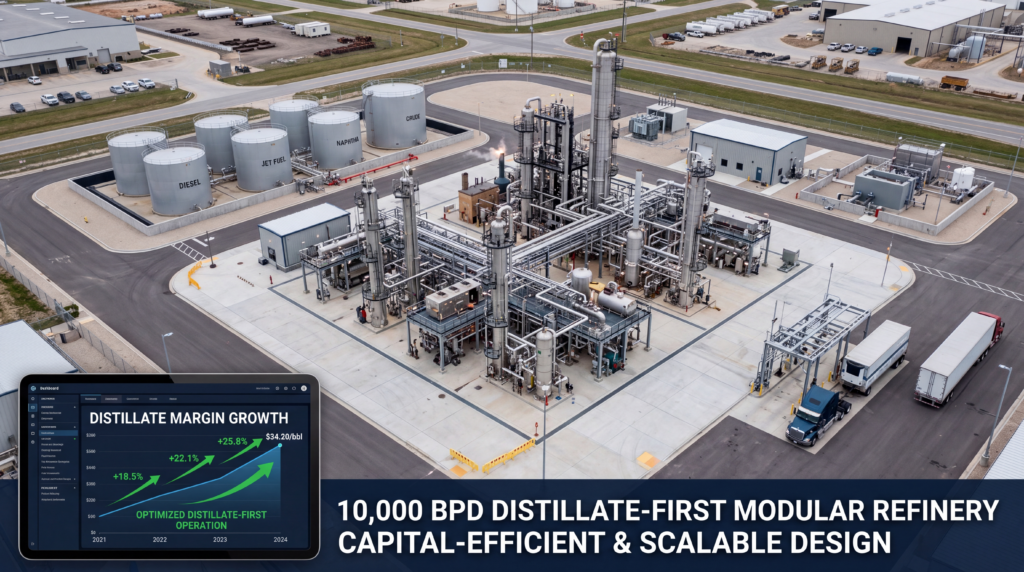
For four decades, the U.S. refining industry has been optimized for gasoline. The cracking ladder — fluid catalytic crackers, alkylation units, catalytic reformers — exists to maximize gasoline yield from a barrel of crude. That configuration was the right answer in 1985. It is the wrong answer in 2026.
The Product Mix Is Inverting
Gasoline demand in the United States peaked in 2018 at 9.3 million barrels per day. It has been falling ever since. The trajectory is structural, not cyclical: vehicle fuel-economy compounding, slow but persistent EV adoption, and demographic shifts in driving patterns are all pushing the same direction. Almost every credible forecast has gasoline demand below 7 million barrels per day by 2035.
Distillate is telling the opposite story. Global jet fuel demand is up 18% since 2019. Marine diesel is structurally short following the IMO 2020 sulfur cap. Sustainable aviation fuel (SAF) — currently around 1% of the global jet fuel slate — is on a regulatory glidepath toward 10% by 2030, which represents the largest distillate hydroprocessing build-out since the 1970s.
What a Distillate-First Refinery Looks Like
A distillate-first refinery is not a conventional refinery with the dials turned. It is a different machine. The configuration drops several of the unit ops that exist purely to make gasoline blendstock and adds hydroprocessing capacity sized for ULSD and SAF specifications.
- Atmospheric distillation tuned for the kerosene/diesel cut
- Hydrocracking before any FCC (often instead of one)
- Hydrotreating sized for ULSD and SAF, not gasoline blendstock
- No catalytic reformer
- No alkylation unit
- Small isomerization or naphtha hydrotreater for the residual naphtha cut
The product slate target is 50%+ distillate yield from a typical sweet crude feed. The remaining barrels go to naphtha (sold as petrochemical feed), residual fuel oil (sold to coker or bunker), and LPG.
The CapEx Math Works
A conventional grass-roots refinery in North America runs $40,000 to $80,000 per barrel of installed capacity, depending on configuration and site. A distillate-first 10,000-bpd modular unit comes in 30-40% below that on a per-barrel basis. The reasons are concrete, not aspirational:
- Fewer unit operations. No FCC. No alkylation. No reformer.
- Modular skid fabrication in a controlled environment, not stick-built on site.
- Smaller footprint and shorter permitting cycle.
- Compressed EPC schedule — 18 months from NTP to mechanical completion.
- Lower fixed engineering cost when paired with AI-augmented engineering tooling.
The Build Window Is Open
There is not a single distillate-first 10,000-bpd merchant refinery operating in North America today. Almost every refinery built in the last 30 years was either gasoline-configured or was a megaproject whose economics depended on scale. The window for a small, modular, distillate-first unit is wider than the industry currently believes.
The team that builds the first one will not look like a conventional EPC firm. It will be a small core team augmented by AI-driven engineering infrastructure — standards engines, automated PFD/P&ID generation, 3D model and point-cloud reconciliation, and a code generator that takes process specs to working DCS configuration directly. The unit ops will be fabricated by modular skid vendors who specialize in repeatable designs. The construction will be a two- to three-month assembly job. The commissioning will be aided by automated loop checks and pre-commissioning analytics.
This refinery is going to be built. The only open question is who builds it first.
Porritt Inc. is a refining-AI software company headquartered in Layton, Utah. The NEXUS suite of engineering tools — including NEXUS CAD, NORMEX Standards AI, and AutoPID — is in production use across the company’s R&D, design, and standards work. Visit porrittinc.com for more.