The Refining Margin Record: Why Diesel Stopped Tracking Crude in 2026
A widest-ever premium over WTI, a record crack spread, and a Gulf storm threat are rewriting oil & gas economics
By Timothy Porritt · Porritt Inc. · October 19, 2026
For most of the last two decades, a refiner’s fortunes tracked the crude tape. When Brent moved, refining-sector equities moved with it, and the story for investors was simple: buy crude exposure, get refining exposure for free. That relationship broke down in 2026, and it broke down in a way that physicists and process engineers will recognize before traders do — as a capacity-constraint problem, not a price problem.
The New York Harbor diesel crack — the price of a gallon of ultra-low-sulfur diesel minus the price of a gallon of the crude oil used to make it — averaged roughly $111 per barrel across September 2026, a record. On September 29 it spiked to roughly $114 per barrel against West Texas Intermediate, putting the premium diesel commanded over the crude it was refined from at $13.40 per barrel — the widest spread on record, nearly double the previous record of $7.80 per barrel. Gulf Coast ultra-low-sulfur diesel cracks tell the same story on a different benchmark: $22.06 per barrel in January 2026, $85.66 per barrel by August. Crude did not quadruple over that stretch. The refining margin did.
That distinction — crude price versus refining margin — is the entire story, and it is worth being precise about why, because the physics and the economics here are the same argument told twice.
What a crack spread actually measures. A crack spread is not a measure of crude scarcity; it is a measure of conversion-capacity scarcity. It isolates the value added by the refining step itself — the distillation, hydrotreating, and catalytic conversion that turns a barrel of crude into transportation fuels — from the value of the crude feedstock. When the crack spread widens sharply while crude prices are flat or falling, the market is saying that the bottleneck has moved downstream, from the wellhead to the distillation column. That is exactly what happened in 2026: Brent crude fell from roughly $116.01 per barrel on September 25 to $101.39 per barrel by October 7, an 81-cent daily uptick that still left it about $15 below its late-September level, while the diesel crack sat at a multi-decade record through the same window. Crude got cheaper. Diesel did not get proportionally cheaper, because the conversion step — not the raw material — is where the shortage lives.
The mechanism is straightforward distillation chemistry and plant-level capacity math. Every crude distillation unit (CDU) has a fixed yield structure for a given crude slate: a barrel of light sweet crude yields a certain fraction of naphtha, a certain fraction of middle distillates (diesel and jet fuel), and a certain fraction of heavier residuum, set by the boiling-point cuts the column is designed around. A refiner can shift that yield slate within a band — running hydrocracker severity harder to favor distillate over gasoline, for instance — but the band has physical limits set by catalyst chemistry, heat-exchanger duty, and metallurgy. When global middle-distillate demand outruns the industry’s collective distillate-yield capacity, no amount of crude-price softening fixes it; only more conversion capacity, or less demand, does. 2026 is a year in which conversion capacity came offline faster than demand softened.
The Anatomy of a Record: What Actually Went Offline
The scale of the 2026 move is not a mystery once the supply side is itemized. Several independent outages compounded through the year rather than arriving as a single shock, which is part of why the market was slow to price the magnitude of the squeeze.
Sanctions have progressively removed Russian distillate from the water. The EU’s initial ban on Russian crude and refined products took effect in late 2022 and early 2023. In July 2025, the EU extended that ban to cover refined products made from Russian crude anywhere in the world — closing the loophole that let diesel refined in third countries from discounted Russian crude reach European ports. In October 2025, the EU tightened sanctions further on Rosneft, Lukoil, and Gazprom Neft specifically, and began targeting refiners in Türkiye and India that process discounted Russian barrels and re-export the diesel into the EU. Each round removed another slice of the arbitrage that had kept European distillate markets loose since 2023.
Ukrainian strikes have been hitting the supply side directly. Attacks on Russian refinery and export infrastructure through 2025 and into 2026 reduced Russia’s own refined-product export volumes, forcing the importers who had relied on that supply to compete harder for what remained from the Middle East, India, and the U.S. Gulf Coast.
Two of the swing producers that normally absorb demand spikes were themselves offline or uncertain. Kuwait’s Al Zour refinery — a 615,000-barrel-per-day complex that came online in 2023 and was built specifically to add heavy conversion capacity to the Middle East export pool — has been offline since late October 2025. Nigeria’s Dangote refinery, the other large swing asset the Atlantic Basin market has leaned on since 2023, produced mixed signals on its maintenance timeline through the back half of 2026, adding uncertainty rather than confidence to the supply picture. A normal maintenance season in the Middle East compounded both: several regional refiners cut processing rates for scheduled turnarounds at the same time Al Zour and Dangote were already question marks.
And U.S. Gulf Coast refiners, who absorb the marginal export demand when the rest of the world is short, were running hard into their own ceiling. U.S. distillate exports in November ran well above the 2020–2024 average. By the October 7, 2026 EIA weekly report, U.S. refinery utilization had already slipped to 92.5% — down from 94.0% the week before — with crude inputs down 554,000 barrels per day to 16.257 million barrels per day, against total U.S. refining capacity of 18.2 million barrels per day, roughly half of it concentrated on the Gulf Coast. That week’s report also flagged six refineries sitting in the direct path of a developing Gulf of Mexico storm system, with offshore Gulf production — about 15% of total U.S. crude output — similarly exposed. U.S. commercial distillate inventories stood at 105.2 million barrels, 14% below the five-year average and 14.9% below the same week in 2025.
Who Actually Captures the Margin
The retail numbers make the crude-versus-margin split impossible to miss. The average U.S. pump price for diesel ran about $3.66 per gallon across 2025. By late September 2026 it had reached $6.29 per gallon — up 72%. Decompose that increase and the source is unambiguous: the crude-oil component rose from $1.56 to $2.32 per gallon, a 49% increase, while the refining-margin component rose from $0.77 to $2.63 per gallon — a 241% increase. Distribution, marketing, and tax costs were essentially flat, at roughly $1.33 to $1.34 per gallon in both periods. Of the roughly $103-per-barrel total rise in diesel’s price since February 2026, crude accounted for about $33 (32%) and the refining margin for about $70 (68%). Two-thirds of what a driver or a trucking fleet paid for that increase went to the refiner that converted the crude, not to the producer that extracted it.
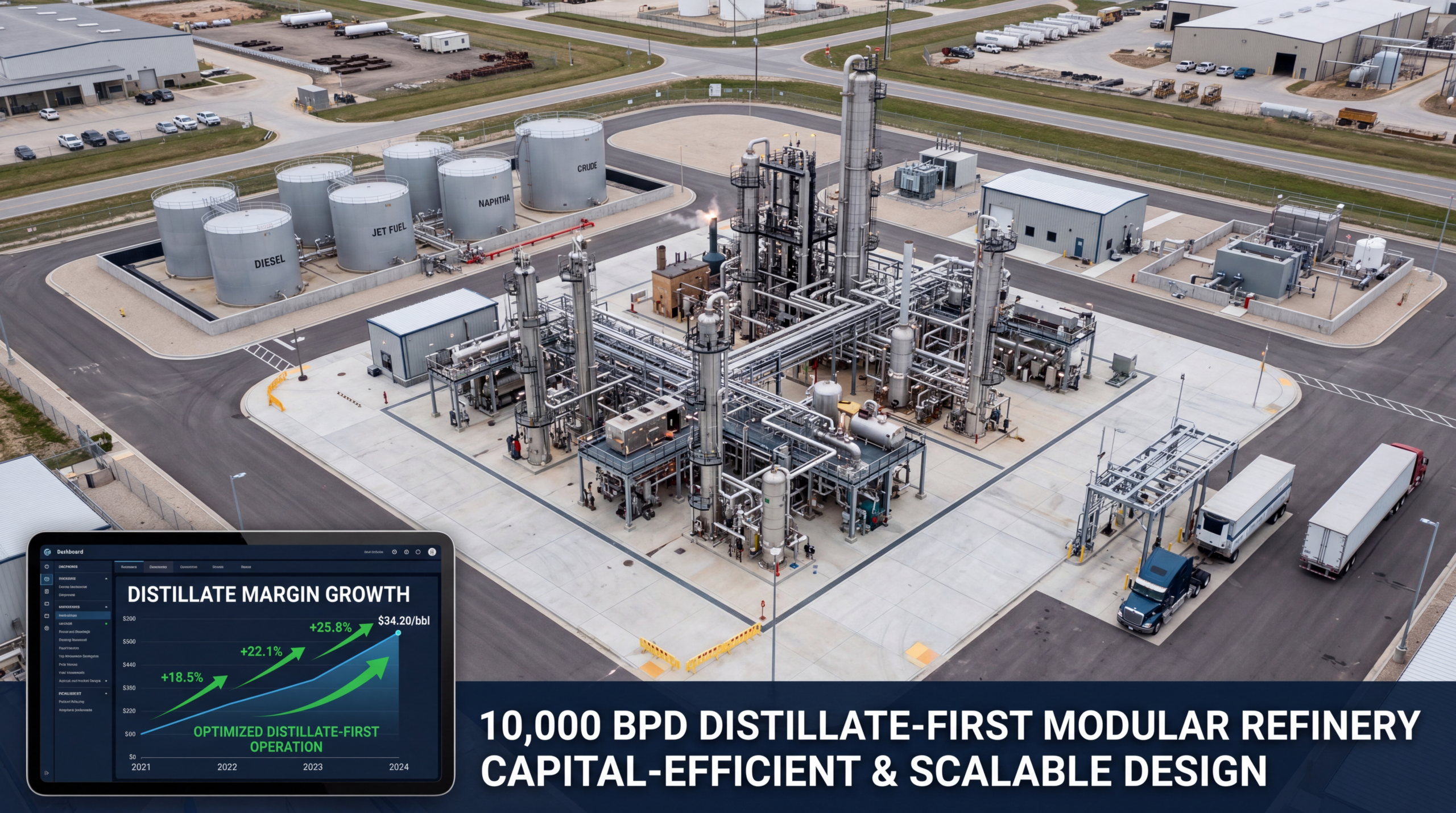
That is an unusual distribution of economic rent in this industry, and it is the detail that should interest DOE policymakers and energy-security planners as much as refining-sector investors. A supply chain where the choke point sits at conversion capacity rather than at the wellhead responds to different levers. Releasing crude from strategic reserves does little to fix a distillate shortage if the bottleneck is downstream of the crude terminal. What moves the number is idle conversion capacity coming back online — Al Zour, Dangote, the sanctioned re-export refiners — or new conversion capacity being built, including the smaller, faster-to-permit modular distillation and hydrotreating trains that have drawn renewed industry interest precisely because the capital and construction timeline for a new grassroots 600,000-barrel-per-day complex is now measured in years the market does not have.
A Record, Not Yet a Collapse
It is worth stating plainly where this sits relative to prior shocks, because markets east and west have genuine historical precedent for distillate spikes receding quickly once a single outage clears. The real-terms high before 2026 was October 2022, when the diesel crack over WTI reached the equivalent of about $106.70 per barrel in August-2026 dollars — itself a shock driven by a single, identifiable cause (the initial wave of Russian sanctions). September 2026’s reading of roughly $111 per barrel average, with a $13.40 widest-ever premium over WTI, exceeded that episode on an inflation-adjusted basis while the underlying causes — sanctions escalation, Ukrainian strikes, two separate swing-refinery outages, and a tight seasonal maintenance calendar — stacked rather than resolved. Measured against the trailing three-year median crack spread, September 2026 came in at 3.19 times that median, above the prior record of 2.96 times set earlier in the cycle, though still well below the extreme outlier readings of 4.7 times (October 2022) and 5.8 times (the January 2000 spike). By early October, the EIA had responded by raising its own Q4 2026 Brent forecast to roughly $105 per barrel — up $14 from its prior estimate — while still projecting a retreat to about $84 per barrel in 2027 as shut-in production returns (the agency projects shut-ins falling to 2.7 million barrels per day) and some of the offline conversion capacity comes back.
The honest caveat for anyone trading or planning against this data: crack spreads are mean-reverting on a timescale of months, not years, once a single large outage clears. Al Zour returning to service, or a definitive resolution on Dangote’s maintenance schedule, would each remove a meaningful slice of the shortfall on its own. The Gulf of Mexico storm threat flagged in the October 7 EIA report is the opposite kind of risk — a short-duration shock that could tighten the U.S. side of the market further before any of the structural fixes land. Both can be true at once: a record that reflects a genuine multi-cause capacity shortfall, and a number that falls meaningfully within two or three quarters once any one of several specific, identifiable fixes arrives.
The Bottom Line
2026’s diesel market is a clean demonstration of a principle every process engineer already knows and every commodities trader is relearning in real time: in a refined-products market, the scarce resource is conversion capacity, not crude. Sanctions, strikes, and swing-refinery outages removed distillate-yield capacity faster than global demand could adjust to its absence, and the price signal that resulted went almost entirely to the refining margin rather than to crude. For an industry whose entire capital-allocation conversation for the past decade has centered on crude supply, 2026 is the year the conversation should have shifted toward distillate-yield capacity, turnaround scheduling resilience, and how quickly new conversion capacity — grassroots or modular — can actually be brought online when the market needs it.
Related reading
- The Distillate Squeeze: Refinery Closures and the Coming Diesel Shortage
- Crude Craters 8.7% on Iran De-Escalation — Diesel Cracks Barely Blinked
- The One Word DOE Just Added to Title XVII That Changes the Math for U.S. Refining
- Distillate Margin Window & Turnaround Economics
Timothy Porritt is founder of Porritt Inc., building AI-powered tools for process safety, engineering compliance, and industrial operations. Based in Salt Lake City, Utah.