
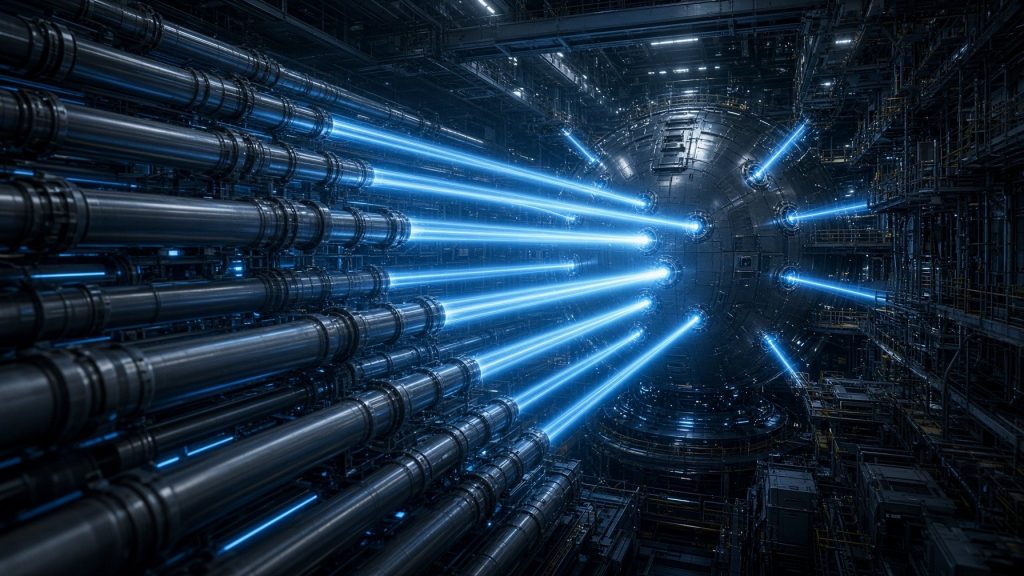
DOE’s October Fusion Scorecard: An AI-Run Tokamak, a 6-Billion-Pulse Capacitor, and a Laser on the Clock
Three Milestone Program companies just reported progress toward a fusion pilot plant — on three different machines, with three different proof points
By Timothy Porritt · Porritt Inc. · November 2, 2026
On October 13, 2026, the U.S. Department of Energy’s Milestone-Based Fusion Development Program logged updates from three of its eight private-sector awardees in the same week: Commonwealth Fusion Systems, Zap Energy, and Xcimer Energy. None of the three announced “first plasma” or a headline energy-gain number. What they reported instead is the less photogenic, more decisive kind of progress — a federal AI mission putting a private tokamak at the center of its first national-lab-grade computing effort, a capacitor rated to outlive the reactor it will eventually power, and a $30.5 million funding tranche gated behind laser hardware that already exists.
That is worth pausing on, because it is a useful corrective to how fusion news usually gets read. The program these three companies sit inside — created under the Energy Act of 2020, first funded in fiscal year 2022, and authorized for up to $415 million through FY2027 under the CHIPS and Science Act — pays out only after an independent technical review confirms a milestone was actually met, and only after the company has already covered more than half the cost itself. It is modeled in part on NASA’s Commercial Orbital Transportation Services program, which is to say: it is built to reward machines that work, not announcements that read well.
The AI Mission Just Put a Private Tokamak at Its Center
The most structurally interesting of the three updates is Commonwealth Fusion Systems’. DOE named CFS the only private company selected to lead a project inside the Genesis Mission — the federal initiative, launched earlier in 2026, that is putting AI to work across 26 science and national-security challenge areas with over $290 million in dedicated AI research funding and collaboration agreements spanning more than twenty organizations, including the major AI labs and compute providers. Everyone else leading a Genesis Mission project line is a national laboratory or a federal agency. CFS is the one private-sector exception.
What CFS is actually building is an AI-enabled digital twin of SPARC, the tokamak the company is assembling in Devens, Massachusetts, with first plasma targeted for 2027. A digital twin in this context is not a visualization layer — it is a model, continuously reconciled against real sensor data, that a plant can use to predict how a change to one parameter (gas puff timing, a magnet’s field ramp, a divertor heat load) propagates through the rest of the machine before that change is actually made. CFS has been building toward this with Nvidia and Siemens on earlier SPARC digital-twin work; the Genesis Mission award adds DOE supercomputing capacity and, more importantly, puts the project inside a federal framework built explicitly to translate national-lab AI tooling into industrial deployment. Cofounder and chief science officer Brandon Sorbom framed the goal as converting “decades of R&D performed across the U.S. fusion community” into a usable operational tool — the point being that the physics knowledge already exists scattered across labs and papers; the digital twin is the mechanism for making a single reactor’s control room actually use it in real time.
Why this matters more than it sounds like it should: a tokamak’s operating envelope is defined by instabilities that develop over milliseconds — a density limit disruption, a locked mode, an edge-localized mode cascade — and the control systems that catch them in time are exactly the kind of high-dimensional, fast-inference problem AI is good at and human operators are not. SPARC is a deuterium-tritium burning-plasma machine, not a toy; getting the control layer right the first time matters more for a reactor that will be producing real neutron flux than it does for a university experiment that can simply power down and try again tomorrow.
A Capacitor Built to Outlive the Reactor
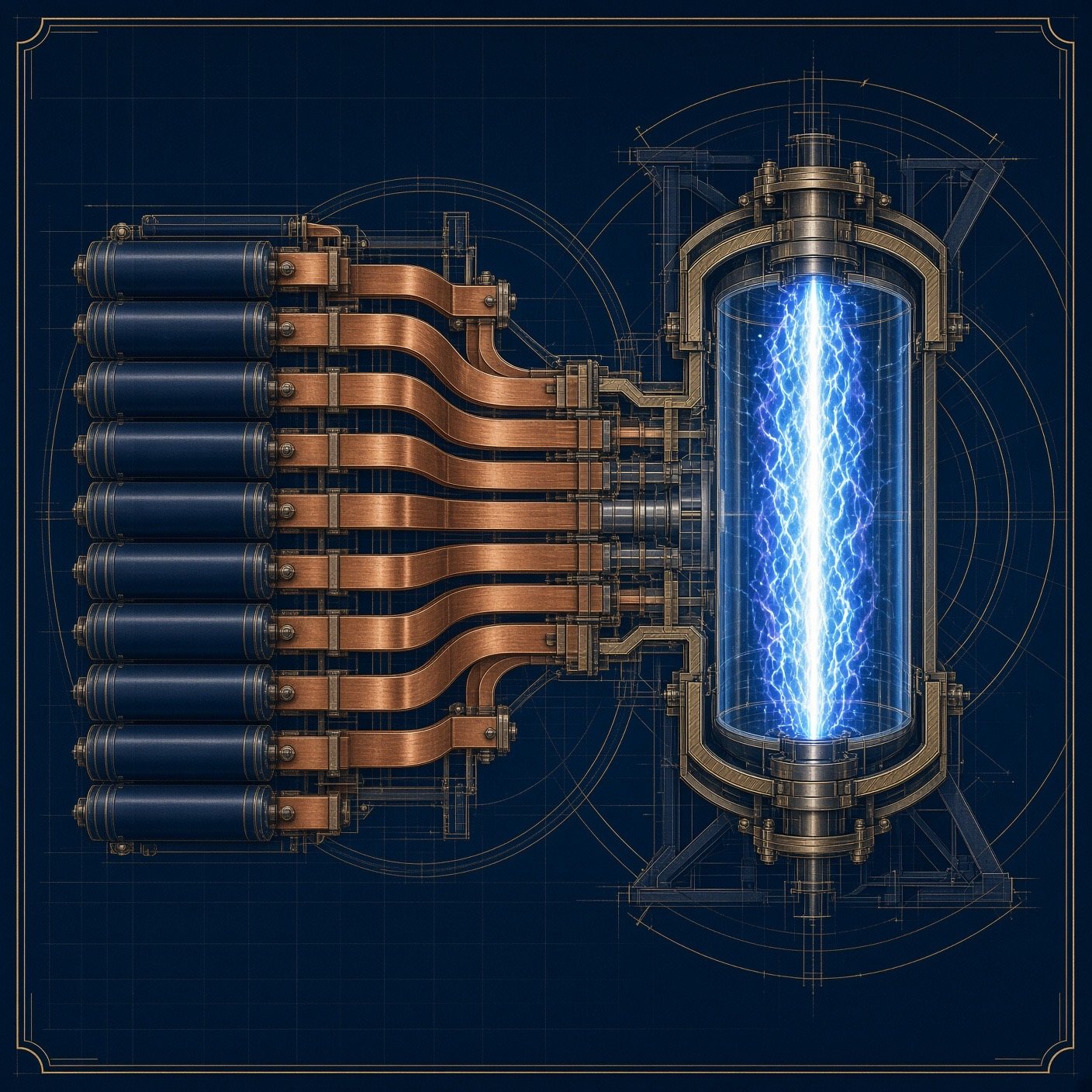
Zap Energy’s update is the opposite kind of milestone — not a systems-level AI framework, but a single component engineered to a number that sounds almost absurd until you understand what it has to survive. Zap’s approach, sheared-flow-stabilized Z-pinch, compresses a roughly 50-centimeter plasma column using pulsed electrical current rather than a continuously-maintained magnetic field or laser compression. That means the pulsed-power hardware — not the plasma physics — is the long pole in the tent for commercial viability, because a power plant needs to do this thousands of times a day, every day, for years.
DOE approved two Zap milestones tied to exactly that hardware. The first is a capacitor rated for 35 kilovolts and 50,000 amps of peak current, designed to a fusion plant’s actual repetition rate and projected to survive 6 billion pulses — a lifetime number that only means anything because it was derived from, and tested against, the plant’s duty cycle rather than a lab bench spec. The second is a first-of-its-kind prototype, built entirely in-house: a 2.8-pound unit cycled hundreds of times at 8 kilovolts and over 7,000 amps, holding its capacitance steady to within 0.25 percent across the test run. CEO Zabrina Johal’s framing was blunt: “Pulsed power is one of those critical enabling technologies” — not the exciting part of a Z-pinch reactor, but the part that decides whether one can run a commercial duty cycle at all.
A Laser Company Gets Paid for Hardware It Already Built
Xcimer Energy’s milestone is the clearest illustration of how the program’s pay-for-performance structure actually works. Xcimer finalized an agreement for up to $30.5 million in additional Milestone Program funding — but that money unlocks only after independent verification of technical and commercialization achievements tied to its excimer laser system, achievements the company had already substantially delivered. Earlier in 2026, Xcimer brought its Phoenix prototype laser system online and received DOE approval of the preconceptual design and technology roadmap for Athena, its planned power plant architecture; the October update formalizes the funding against that already-completed work rather than promising future progress. Cofounder and CEO Conner Galloway described the shift in blunt terms: “We have moved from proving that the physics works to building the industrial technology.” Xcimer’s inertial confinement approach targets grid electricity delivery in the mid-2030s — the furthest-out of the three companies’ public timelines, consistent with inertial fusion energy’s generally later commercial runway relative to magnetic confinement.
Three Approaches, Three Honest Comparisons
It is tempting to rank these three against each other, and it would also be a mistake. Commonwealth Fusion’s magnetic-confinement tokamak has the most mature public timeline — first plasma on SPARC in 2027 — but a tokamak’s complexity is exactly why an AI digital twin is worth a dedicated federal mission line: there is more to control, and more that can go wrong quickly, than in a simpler machine. Zap Energy’s Z-pinch is mechanically the simplest reactor concept of the three, which is precisely why its milestone this month was a capacitor and not a plasma result — the physics risk is lower, but the pulsed-power engineering risk is now the whole game. Xcimer’s laser-driven approach carries the longest timeline but the most unambiguous current milestone: hardware that exists today, independently verified, with money released strictly against that verification rather than a roadmap promise.
None of this is a horse race with a single winner. The Milestone Program’s design assumes several of these companies, or none of them, clear the bar DOE actually cares about: a credible, cost-shared path to a pilot plant design within five to ten years of the 2023 selection. Eight companies were chosen; three reported real progress in the same October week. That clustering is itself informative — it suggests a program entering its middle innings, where early design work is giving way to hardware that either performs to spec or doesn’t.

What This Means Past the Fusion Community
For DOE, the Genesis Mission selection of CFS is a signal worth tracking independent of fusion: a federal AI initiative built mostly around national laboratories just handed its first private-sector leadership role to a company whose actual deliverable is controlling a burning-plasma machine in real time. If that digital twin framework works, it is a template other advanced-energy operators — including conventional nuclear and, eventually, modular process facilities — will want to copy, because the underlying problem (reconcile a fast physical process against a model, in real time, with safety margins that can’t be re-derived after the fact) is not unique to tokamaks.
For the AI infrastructure conversation specifically, the throughline is less about fusion supplying power to data centers — these three companies are years from grid electricity regardless of approach — and more about AI supplying the control layer fusion needs to get there faster. The capital story underneath all of it remains real: Milestone Program awardees have raised over $350 million in new private funding since the 2023 selections, against $46 million in initial federal seed money, a roughly 7-to-1 private-to-public ratio that is the actual argument for the program’s design, independent of any single company’s October headline.
The Part That Doesn’t Make the Headline
The physics that matters here is almost all in the words “repetition rate” and “duty cycle.” A single impressive pulse — one hot plasma, one high-field magnet, one clean laser shot — has been achievable in fusion research for decades. A pilot plant has to do it continuously, at a rate and reliability that makes the economics work, which is exactly why Zap’s milestone was a capacitor’s pulse count and not a fusion yield, and why CFS’s AI investment is aimed at keeping SPARC inside its operating envelope automatically rather than through operator intervention after the fact. Xcimer’s $30.5 million, similarly, is not funding for an idea — it is a check written against a laser that already fired. None of the three companies announced the fusion breakthrough a general-audience headline would want. All three reported the kind of progress that determines whether a pilot plant gets built on schedule.
Related reading
- The Physics Is Now on the Record: CFS Publishes the ARC Basis as DOE Locks the National Fusion Roadmap
- The $293 Million Question: Can AI Actually Replace a Senior Process Engineer’s Gap Analysis?
- 20 Days Until the Genesis Mission Deadline — What I’ve Learned Competing Against Google and J.P. Morgan for DOE Funding
- $293 Million for AI in Science — Why DOE’s Genesis Mission Matters for Industrial Engineering
Timothy Porritt is founder of Porritt Inc., building AI-powered tools for process safety, engineering compliance, and industrial operations. Based in Salt Lake City, Utah.

