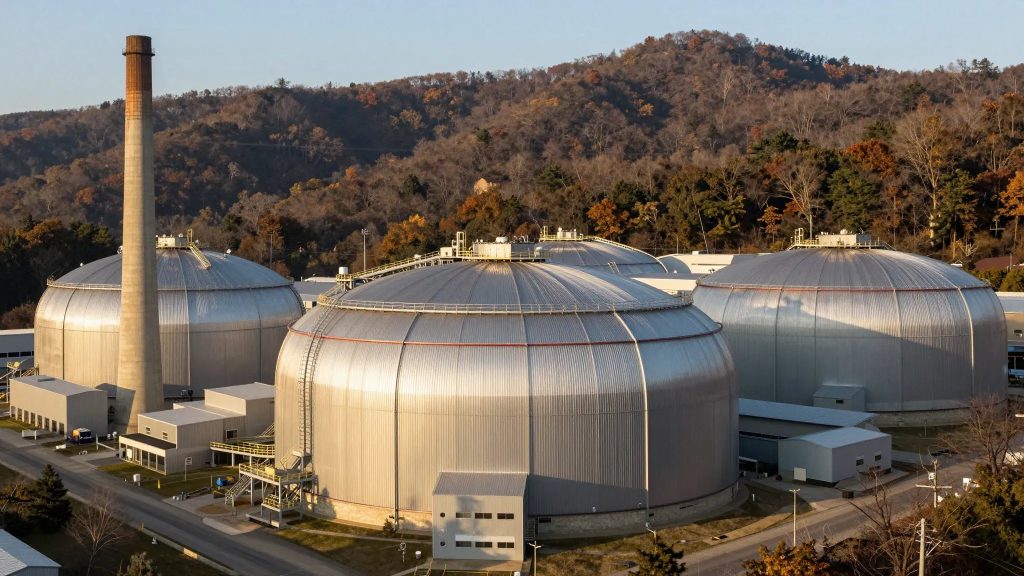
America’s First Commercial Fusion License Just Landed
Tennessee didn’t just approve a stellarator — it wrote the rulebook every other fusion developer in the country now gets to borrow.
By Timothy Porritt · Porritt Inc. · September 21, 2026
On August 31, 2026, the Tennessee Department of Environment and Conservation issued the first license in United States history authorizing a company to operate a commercial fusion machine. The recipient, Knoxville-based Type One Energy, can now break ground on the first phase of Project Infinity at the Tennessee Valley Authority’s Bull Run Energy Complex, a retired coal plant site near Oak Ridge. The announcement drew Tennessee Governor Bill Lee, TDEC Commissioner David Salyers, TVA Interim President and CEO Mike Skaggs, and Type One CEO Chris Mowry to Nashville for the state’s Organization of Agreement States annual meeting — deliberately timed so the industry’s state radiation-control directors were in the room when it happened.
The plasma physics here is not new. What’s new — and what actually matters — is the paperwork. For fifteen years, “when will fusion get licensed” has been as large an obstacle to commercialization as “when will fusion ignite.” Tennessee just answered the first question, and the answer is: faster than most of the industry expected, and at the state level rather than waiting on a single federal process.
How a State Ended Up Licensing a Fusion Reactor
The path here runs through a decision the Nuclear Regulatory Commission made back in April 2023: fusion energy systems would be regulated as byproduct material facilities — the same licensing category used for medical isotopes, industrial radiography sources, and university research reactors’ auxiliary systems — rather than as full Part 50/52 nuclear power reactors. That single classification choice is why Tennessee, not the NRC, issued this license. Byproduct-material authority can be delegated to “Agreement States” that have demonstrated an equivalent regulatory program, and Tennessee is one of 39 such states.
In February 2026, the NRC proposed an augmented byproduct-material framework specifically to “accommodate the wide variety of anticipated fusion machine designs across the National Materials Program” — recognizing that a laser inertial-confinement system, a tokamak, and a stellarator present genuinely different hazard profiles that a one-size-fits-all rule would handle poorly. Tennessee moved fast: it stood up its own state-level fusion regulatory framework, which took effect in June 2026, and Type One’s application became the first test case. Ninety days later, they had a license.
Why this is faster than it sounds: a byproduct-material license deals with radiological source terms, shielding, and material control — not the multi-year construction permit and operating license review that a fission power reactor undergoes under 10 CFR Part 50. Fusion’s own physics does a lot of the safety case’s work: there is no chain reaction to run away, no possibility of core meltdown, and the radiological inventory in a stellarator’s plasma-facing components is orders of magnitude smaller than a fission core’s. Type One CEO Chris Mowry put it plainly: “For the first time, a fusion power plant–specific licensing process has been developed and then used to grant a fusion-specific license to operate a fusion machine, consistent with a national regulatory framework for fusion energy… Tennessee’s licensing process is now the international benchmark for how to ensure fusion power plant ‘safety by design.'”
What Gets Built at Bull Run
The license covers the first phase of a two-machine build-out. Infinity One is a stellarator prototype — its job is to demonstrate Type One’s modular high-temperature superconducting (HTS) magnet system at scale, validate stellarator plasma performance against a metallic first wall, and confirm reduced turbulent heat loss and improved exhaust handling. It is a proof machine, not a power plant.
Infinity Two is the power plant: a deuterium-tritium stellarator designed to produce roughly 800 megawatts of fusion power, delivering approximately 400 megawatts net to the grid — a thermal-to-electric conversion efficiency in the neighborhood of 50 percent, in line with modern combined-cycle gas plants rather than the ~33–37% typical of legacy steam-cycle nuclear. Type One expects full startup of Infinity Two by 2034.
The HTS magnet approach matters here because it’s the single largest engineering bet in modern stellarator design. Type One holds access to Commonwealth Fusion Systems’ HTS cable technology under a 2025 partnership — the same magnet-technology lineage behind CFS’s SPARC tokamak — applied to a fundamentally different confinement geometry. A stellarator’s twisted, non-axisymmetric coil set is dramatically harder to manufacture than a tokamak’s toroidal coils, but it buys something a tokamak can’t offer as easily: steady-state operation without the disruption risk that comes from driving plasma current around a tokamak’s loop. Type One is betting that better magnets and modern computational optimization — machine-learning-assisted coil-shape design, in particular — finally make that manufacturing complexity tractable at commercial scale.
Bull Run itself is being built as more than a single company’s site. TVA, Oak Ridge National Laboratory, and the University of Tennessee are all slated to run collaborative work there, turning the retired coal plant into what Type One and TVA are calling a fusion development campus — a deliberate echo of how Oak Ridge became the country’s nuclear materials science hub in the first place.
Who’s Paying, and What the Money Says About the Bet
Type One’s capital stack tells its own story about where investor confidence sits in the fusion race. The company holds the largest single Department of Energy stellarator award on record — $5 million in 2023, at a time when nearly every other public DOE fusion dollar was flowing to tokamak and inertial-confinement concepts. Since then, it closed an oversubscribed convertible note round north of $80 million and has been raising a Series B reported at $250 million on a $900 million pre-money valuation. That’s real money betting on a confinement geometry — the stellarator — that spent decades as the “someday” option behind the tokamak.
The regulatory milestone changes the risk calculus for that capital. A construction site with an issued operating license de-risks the next funding round in a way that a pile of simulation results cannot. Expect this license to show up explicitly in Type One’s Series B materials, and expect other fusion developers — public and private — to cite Tennessee’s framework as evidence that licensing timelines are no longer an open-ended unknown in their own financial models.
The Competitive Field, Honestly
Type One is not the fusion industry’s pace-setter on net energy gain — that distinction currently sits with tokamak developers. Commonwealth Fusion Systems’ SPARC, under construction in Massachusetts, is targeting net fusion energy gain (Q>1) using the same class of HTS magnet technology Type One licenses, and CFS remains the best-funded private fusion company in the world. On raw physics milestones, the tokamak lineage — CFS, plus publicly funded programs like ITER and the UK’s STEP program, which announced new manufacturing partnerships this month — is ahead.
What Type One has now is something none of them have: an issued, fusion-specific operating license at a real construction site, on a public timeline, under a state framework other Agreement States can adopt wholesale. Proxima Fusion, the other major stellarator developer, signed a memorandum of understanding with Germany’s Lower Saxony state in September 2026 to scale HTS tape production — a strong supply-chain move, but not a license to operate. Helion Energy’s field-reversed-configuration approach sidesteps magnetic confinement entirely and has its own commercial timeline with Microsoft, but it hasn’t gone through a comparable state licensing process yet either. Each approach is racing on a different track — plasma performance, supply chain, or regulatory precedent — and this month, Type One won the regulatory track outright.
Why This Belongs in the Genesis Mission Conversation
The Department of Energy’s Genesis Mission — the AI-for-science initiative launched by executive order in November 2025 — explicitly names “Accelerating Delivery of Fusion Energy” as one of its 26 national science and technology challenges, and it targets exactly the two bottlenecks this story touches. The DOE’s own framing calls for an “AI-Fusion Digital Convergence Platform” that unifies plasma, materials, and system-level digital twins to compress the design-build-test cycle across six roadmap areas: structural materials, plasma-facing components, confinement approaches, the fuel cycle, blankets, and plant engineering. A licensing pathway that takes 90 days instead of several years is the regulatory-side complement to that engineering-side acceleration — Genesis Mission’s stated goal for nuclear more broadly is “at least 2x schedule acceleration and greater than 50 percent operational cost reductions” through AI-assisted design, licensing documentation, and digital-twin-driven operations. Tennessee’s framework shows that the schedule acceleration doesn’t have to wait for the AI tooling to mature; state-level regulatory innovation can move first, and the AI-driven engineering tools DOE is funding now will compound on top of it.
What to Watch Next
Three things determine whether Bull Run stays the exception or becomes the template. First, whether the NRC finalizes its augmented byproduct-material rule roughly as proposed, giving every Agreement State a federal reference framework to adopt rather than each having to build one from scratch, the way Tennessee did. Second, whether other Agreement States with active fusion prospects — several southern and western states host serious private fusion efforts — move to replicate Tennessee’s framework rather than default to the slower path of waiting on individual NRC guidance. Third, and most directly relevant to Type One’s own timeline, whether Infinity One’s construction and early operation at Bull Run stay on schedule through the early 2030s, since a licensing win means nothing commercially if the underlying stellarator physics doesn’t scale from prototype to the 400-megawatt Infinity Two design.
None of that is guaranteed. But for the first time, “we don’t know how long licensing will take” is no longer the biggest unknown on a private fusion developer’s critical path in the United States. That’s the actual milestone Tennessee delivered on August 31 — not a plasma record, a paperwork record, and in a technology this capital-intensive, that’s the record that unlocks the next one.
Related reading
- The Race to Power AI: Why Helion’s Direct Energy Conversion Is the Fastest Path to Fusion Electricity
- Eighteen Months to Eight Weeks: AI Digital Twins Are Now Nuclear’s Throughput Play
- DOE’s October Fusion Scorecard: An AI-Run Tokamak, a 6-Billion-Pulse Capacitor, and a Laser on the Clock
- The Physics Is Now on the Record: CFS Publishes the ARC Basis as DOE Locks the National Fusion Roadmap
Timothy Porritt is founder of Porritt Inc., building AI-powered tools for process safety, engineering compliance, and industrial operations. Based in Layton, Utah.