Small Modular Reactors: The Factory-Built Future of Nuclear Power
How compact, scalable reactors are reshaping the global energy landscape

Nuclear energy is undergoing a quiet revolution — not through massive, centralized plants, but through compact, modular designs that can be factory-built and shipped to virtually any site. Small Modular Reactors (SMRs), broadly defined as reactors producing up to 300 megawatts of electricity (MWe), are attracting unprecedented investment from tech giants, governments, and utilities worldwide.
What Is an SMR?
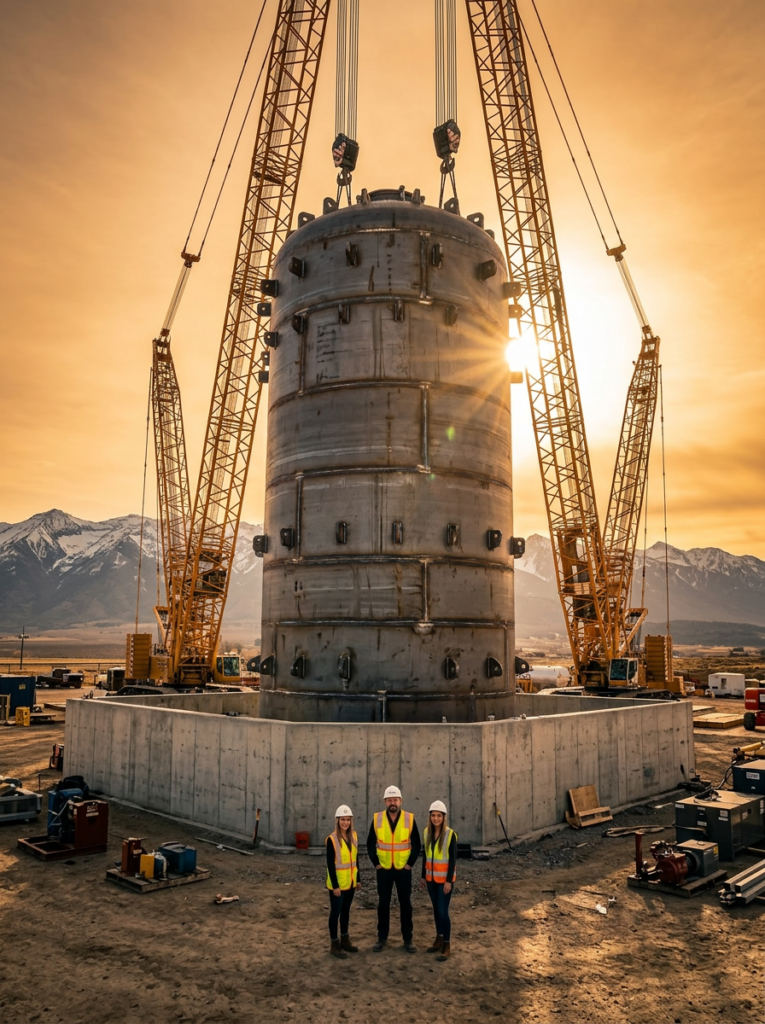
Traditional nuclear plants are enormous — often exceeding 1,000 MWe — and require decades of on-site construction at costs that frequently balloon past $10 billion. SMRs flip this model. By standardizing smaller reactor designs and manufacturing them in controlled factory environments, developers aim to deliver nuclear power faster, cheaper, and with greater flexibility. A single NuScale Power Module, for example, produces 77 MWe, and multiple modules can be combined in arrays of up to 12 units — offering a total output of up to 924 MWe. NuScale currently stands as the only SMR developer to have received full design certification from the U.S. Nuclear Regulatory Commission (NRC), with its 77 MWe design earning approval in 2025.
A Spectrum of Technologies
The International Atomic Energy Agency (IAEA) catalogued 83 active SMR designs in its 2024 edition of the Small Modular Reactor Technology Catalogue, spanning four core technology families: water-cooled reactors (the most mature approach), high-temperature gas-cooled reactors, liquid-metal cooled fast-spectrum reactors, and molten salt reactors. This diversity reflects both the breadth of current innovation and the recognition that no single design will fit every use case. TerraPower’s Natrium reactor, for instance, pairs a 345 MWe sodium-cooled fast reactor with a molten salt energy storage system that can surge output to 500 MWe during peak demand — a uniquely flexible profile for grids with high renewable penetration. Construction began at a retiring coal plant site in Kemmerer, Wyoming in June 2024, with commercial operation targeted for 2031.
Big Tech Bets Big
One of the most dramatic signals of SMR momentum is the entry of major technology companies. In October 2024, Google became the first corporation to sign a commercial SMR purchase agreement, partnering with Kairos Power to deploy 500 megawatts across 6–7 molten fluoride salt-cooled reactors, with the first unit targeted for 2030. Microsoft has simultaneously pursued nuclear power through a 20-year agreement with Constellation Energy to restart Three Mile Island Unit 1 (a conventional reactor) while building an internal nuclear team to explore SMRs for its global data center portfolio. Oracle’s Larry Ellison announced plans for a 1 GW data center campus powered by three SMRs, and Meta solicited proposals for up to 4 GW of new nuclear generation. NuScale’s exclusive commercial partner, ENTRA1 Energy, signed a landmark agreement with the Tennessee Valley Authority (TVA) to deploy up to 6 gigawatts of SMR capacity — the largest SMR deployment program in U.S. history.
Global Momentum
The SMR race is not limited to the United States. Canada granted construction approval in April 2025 for a GE Hitachi BWRX-300 at Ontario Power Generation’s Darlington site — a CAD 7.7 billion project targeting operation by 2029. Romania is pursuing a NuScale six-module VOYGR plant targeted for 2029. The European Union selected nine SMR projects for its Industrial Alliance, and the United Kingdom has committed £280 million in government funding to Rolls-Royce’s 470 MWe SMR design. Poland has committed to multiple SMR deployments to replace coal plants, leading an 11-country consortium.
The Economic Reality
Current first-of-a-kind SMR projects face significant capital costs — estimated at $3,000–6,000 per kilowatt — which are higher than utility-scale wind and solar. However, developers project these costs will decline sharply through series production and factory manufacturing. The levelized cost of electricity from SMRs currently ranges from $89–102 per megawatt-hour, higher than renewables but competitive with other firm, baseload alternatives when considering capacity factors exceeding 95%. NuScale’s proposed 920 MW plant would require only about 35 acres, which is far smaller than an equivalent solar installation.
Challenges Ahead
The path to commercial deployment is not without obstacles. Many advanced SMR designs require High-Assay Low-Enriched Uranium (HALEU), a fuel type whose global supply chain is currently limited. TerraPower has secured a 10-year enrichment contract with a South African company to address this challenge. Regulatory timelines remain a key risk — while NuScale’s NRC certification took years to achieve, the agency is actively working to streamline review processes for advanced reactor designs, with a new Part 53 rulemaking framework expected to be operational by 2027. The NRC has already committed to completing licensing reviews for new advanced reactors within 18 months.
SMRs represent the most credible near-term path to expanding carbon-free baseload nuclear power at scale. With construction underway in multiple countries and major corporations placing large bets, the factory-nuclear era is beginning.