PORRITT INC. — ENERGY INTELLIGENCE BRIEF
Nuclear Fusion Analysis Series — April 2026

The Problem: 1,100 Terawatt-Hours and Counting
The IEA projects global data center electricity consumption will hit 1,100 TWh in 2026 — equivalent to Japan’s entire national consumption. The Uptime Institute estimates 10 GW of that load is specifically AI-driven. Microsoft, Google, Amazon, and Meta have collectively committed to over 10 gigawatts of new nuclear capacity in the last 12 months alone.
This is not a future problem. This is a physics problem happening right now. And the only energy source that delivers carbon-free, 24/7 baseload power at the gigawatt scale without depending on geography, weather, or fossil fuels is nuclear.
The question is no longer if nuclear powers the AI era. The question is which nuclear. And on the fusion side, one company has separated itself from the field — not by raising the most money, but by solving the most fundamental physics problem differently than everyone else.
Why Helion: The Field-Reversed Configuration and Direct Energy Conversion
Every other serious fusion contender — Commonwealth Fusion Systems, TAE Technologies, Tokamak Energy — follows the same energy extraction model that fission plants have used since the 1950s: capture thermal energy from the reaction, boil water, spin a turbine, generate electricity. The fusion plasma is the heat source; everything downstream is conventional thermodynamics.
Helion Energy skips the entire thermal cycle.
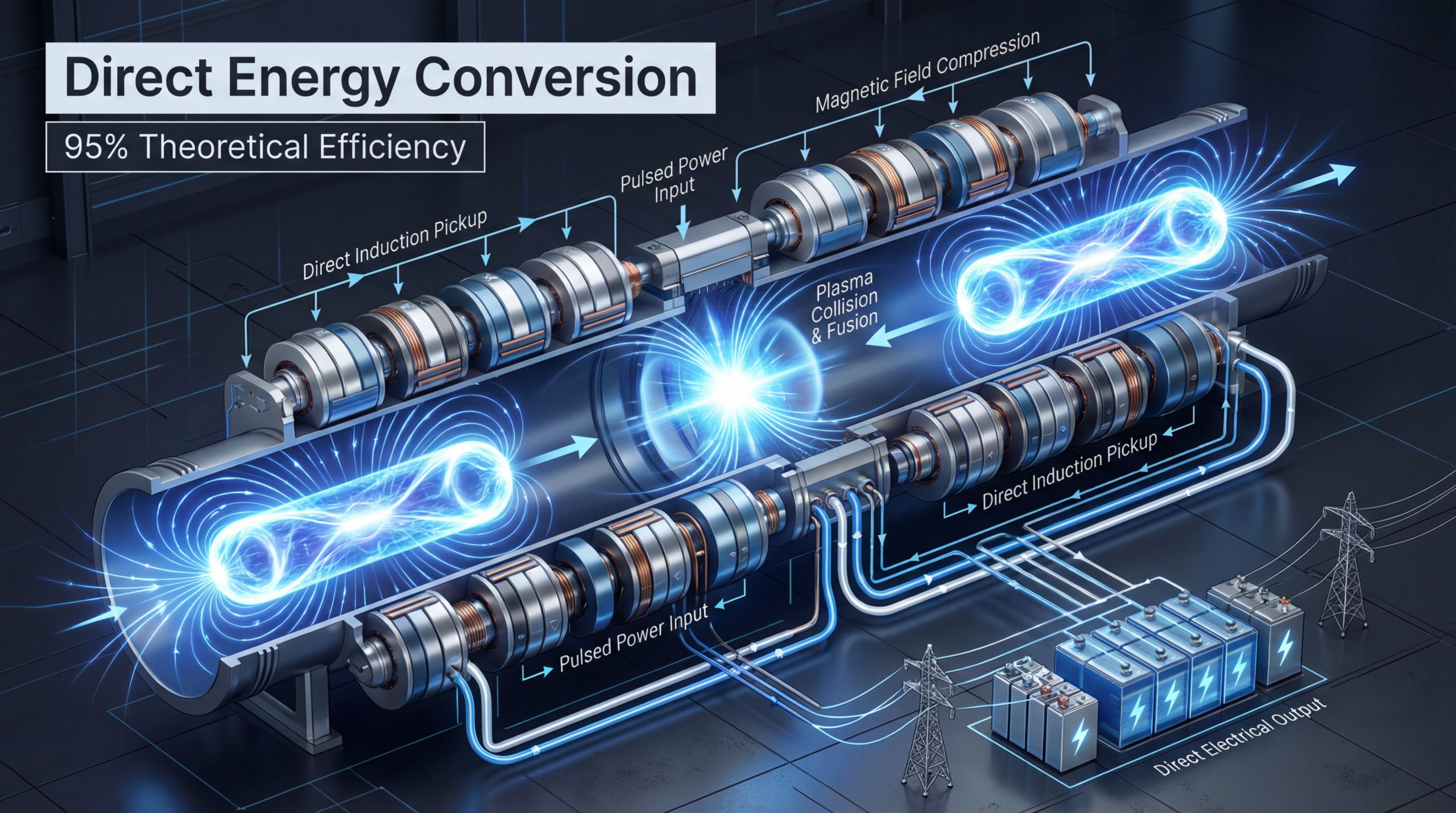
Helion’s approach uses a pulsed field-reversed configuration (FRC) in which two plasmoids are magnetically accelerated to ~1,600 km/s from opposite ends of a linear accelerator, collide at the center, and compress under a powerful magnetic field until they reach fusion temperatures. When the fused plasma expands, it pushes back against the confining magnetic field — and that expanding magnetic flux induces current directly in the surrounding coils.
This is direct energy conversion. No steam. No turbine. No Rankine cycle. No cooling towers. The plasma’s kinetic energy converts to electricity through electromagnetic induction — the same principle as regenerative braking in an electric vehicle, but at 150 million degrees Celsius.
For a physicist, the elegance is immediately apparent: you eliminate the single largest source of thermodynamic loss in any power plant. A conventional thermal cycle (fission or fusion-to-steam) operates at 33–40% efficiency, bounded by Carnot. Helion’s direct conversion pathway has a theoretical efficiency ceiling above 95%, though the engineering reality will land lower. Even at 50–60% system efficiency, you’ve leapfrogged every thermal plant ever built.
The February 2026 Milestone: What 150 Million Degrees Actually Means
On February 13, 2026, Helion announced that its seventh-generation prototype, Polaris, achieved 150 million degrees Celsius in a deuterium-tritium plasma — making it the first privately funded fusion device to operate with D-T fuel and exceed 100 million degrees Celsius.
Context matters here. The often-cited “fusion temperature” threshold of 100 million degrees refers to the approximate ion temperature needed for D-T fusion to become self-sustaining in a magnetically confined plasma (the Lawson criterion, accounting for confinement time and density). Helion’s 150M°C is three-quarters of the way to their 200M°C commercial target — a target set higher than competitors’ because the FRC approach operates at different confinement parameters than a tokamak.
The D-T milestone is particularly significant because tritium handling requires NRC-regulated radiological infrastructure. Running D-T in a private facility signals engineering maturity, not just plasma physics achievement. Helion bred and used its own tritium — a closed fuel cycle demonstration that most national labs haven’t achieved.
The Commercial Path: Orion and the Microsoft PPA
Helion is not waiting for SPARC’s first plasma or ITER’s decade-long construction timeline. The company is already building Orion, a 50 MW commercial fusion power plant in Malaga, Washington — near Microsoft’s expanding data center campus in Chelan County. Microsoft signed a power purchase agreement for Orion’s output, with a target operational date of 2028.
50 MW is modest by grid standards. But it’s not meant to be a grid plant — it’s meant to be a dedicated power source for a single hyperscale data center campus. That’s the deployment model that changes the economics: skip the utility, skip the transmission, generate power at the point of consumption.
For comparison: a single NVIDIA GB200 NVL72 rack draws ~120 kW. A 50 MW Helion plant powers roughly 400 of those racks — a meaningful AI training cluster. Scale to Helion’s planned multi-unit configurations and you’re powering the kind of compute campus that OpenAI, Anthropic, and Google DeepMind are desperately trying to build.
The Competition: CFS, TAE, and Why Helion Leads the Clock
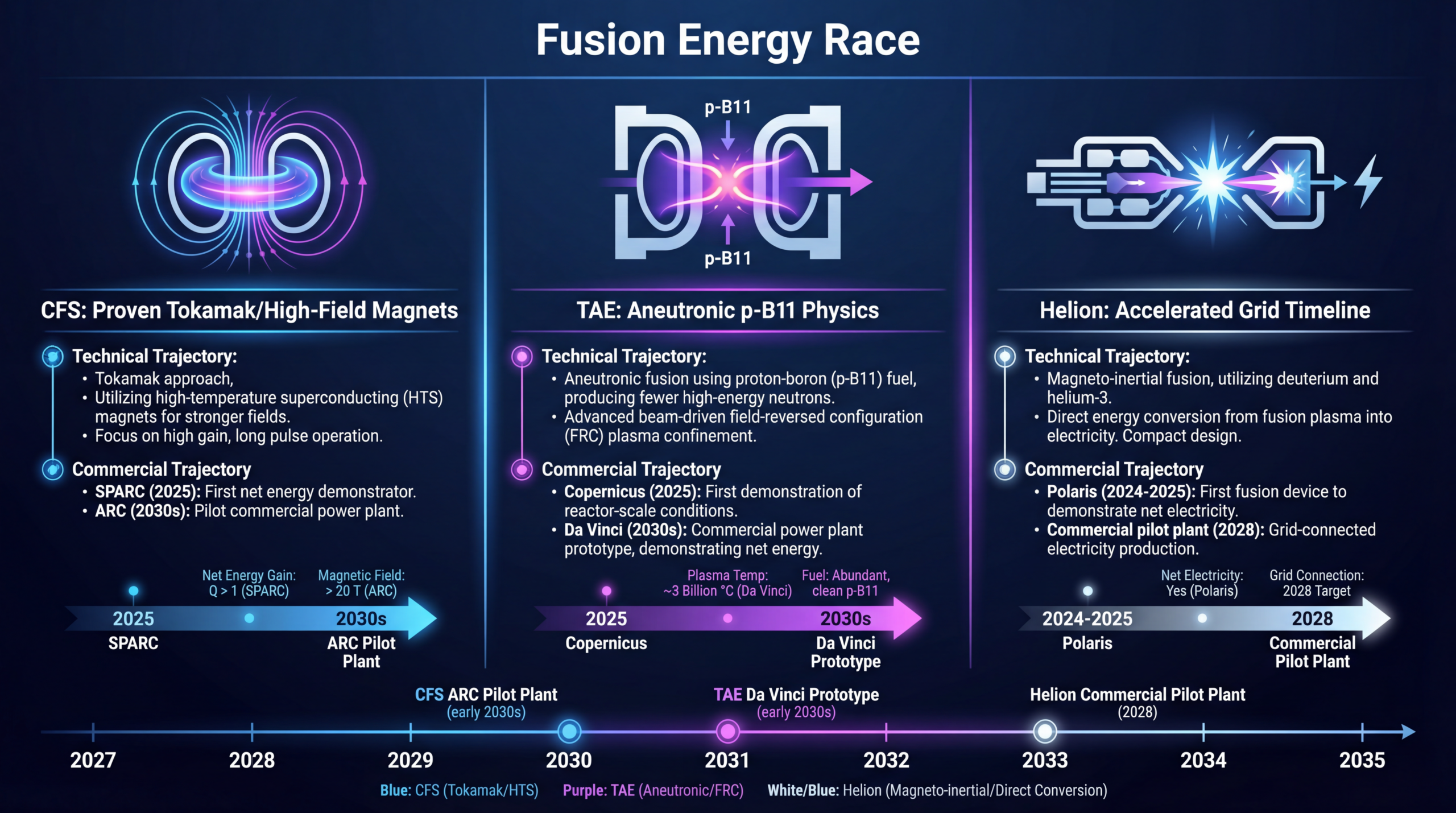
Commonwealth Fusion Systems is the heavyweight — ~$3 billion raised, MIT pedigree, DOE-validated 20 Tesla HTS magnets (world record for high-temperature superconducting coils). SPARC is under construction in Devens, MA, with the first of 18 toroidal field magnets installed in January 2026. First plasma is targeted for 2027, with the commercial ARC plant (400 MWe) planned for the early 2030s in Virginia. Google signed a 200 MW PPA. CFS is the institutional favorite — the tokamak approach is well-understood, the magnet technology is proven, and the path from SPARC to ARC is conventional scale-up engineering.
But CFS’s timeline to grid power is 2032–2035. Helion’s is 2028.
TAE Technologies is pursuing hydrogen-boron (p-B11) aneutronic fusion — the holy grail fuel cycle that produces no neutrons and therefore no radioactive waste. TAE demonstrated the first-ever H-B11 fusion in a magnetically confined plasma in collaboration with Japan’s NIFS. The physics is beautiful, but p-B11 requires ~3 billion degrees Celsius (vs. 200M°C for D-T). TAE’s Copernicus prototype targets net energy by late decade; Da Vinci (first power plant) is early 2030s. The Trump Media merger valued TAE at $6 billion and plans a 50 MW plant to begin construction in 2026 — but the commercial timeline is still behind Helion’s.
Helion leads on one metric that matters more than funding, pedigree, or physics elegance: time to watts on the grid.
What This Means for DOE and the Genesis Mission
The Genesis Mission’s challenge areas include “Accelerating the Clean Energy Transition” and “Modernizing the Grid.” The implicit assumption in most DOE fusion funding is that commercial fusion is a 2040s technology. Helion’s timeline challenges that assumption by a full decade.
If Helion delivers Orion by 2028 — even at reduced capacity, even as a demonstration — it reshapes the DOE’s entire fusion commercialization roadmap. The policy implication is that private fusion may outrun public fusion (ITER, scheduled for first plasma in 2035) by nearly a decade. The funding implication is that Phase I and Phase II awards supporting fusion-adjacent technologies (grid integration, tritium supply chains, plasma diagnostics, AI-driven confinement optimization) become immediately relevant rather than speculative.
For an agency that has spent $30+ billion on ITER and decades on the “fusion is 30 years away” narrative, a private company putting 50 MW on the grid in Washington State by 2028 is not an incremental development. It’s a paradigm break.
The Physics That Matters
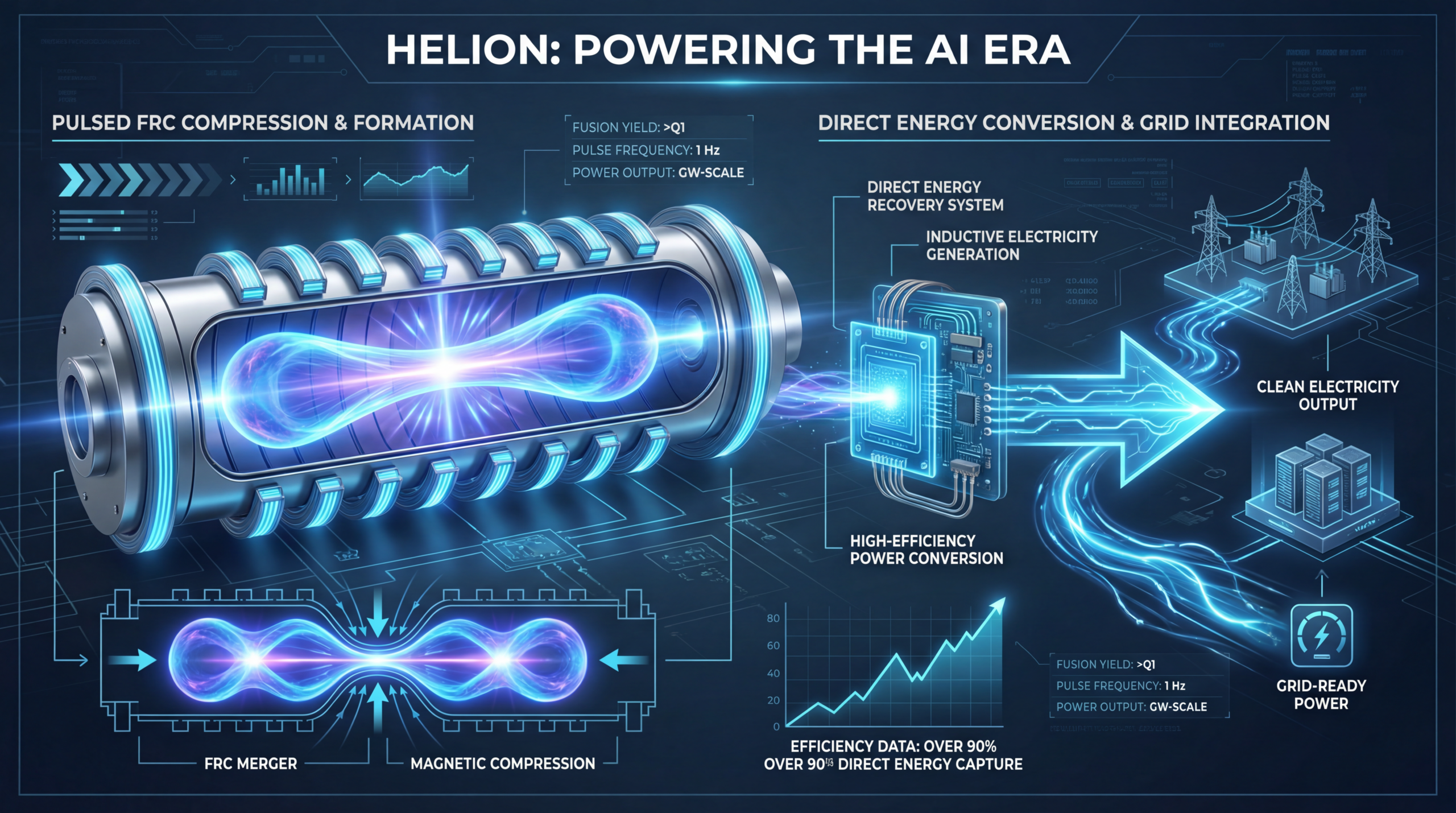
Helion’s bet is that you don’t need to solve the hardest problem in plasma physics (sustained ignition at Q >> 1) to make commercially viable fusion electricity. By using pulsed FRC compression and direct energy conversion, the system can operate at Q < 1 (energy gain less than breakeven) and still produce net electricity — because the direct conversion pathway recovers energy that a thermal cycle would waste.
This is counterintuitive. Every other fusion company defines success as Q > 1. Helion defines success as net electricity to the grid, regardless of Q. The physics allows it because the energy recovery mechanism is electromagnetic, not thermal.
Whether this works at commercial scale is the $5.8 billion question (Helion’s total funding to date). But the physics is sound, the engineering is underway, and the timeline is 22 months away.
The race to power the AI era won’t be won by the company with the most elegant plasma physics. It will be won by the company that puts watts on a wire first. Right now, that company is Helion.
Timothy Porritt is founder of Porritt Inc., building AI-powered tools for heavy industry including NEXUS CAD and NORMEX Standards AI. A petroleum engineer by training, Timothy writes about the intersection of industrial engineering, AI, energy, and entrepreneurship.